Portfolio Choice with Risky Housing
December 15, 2021
Christopher Carroll1
JHU
Alan Lujan2
OSU
Mateo Velásquez-Giraldo3
JHU
_____________________________________________________________________________________
Abstract
This paper develops a state-of-the-art computational model of optimal choices for household
spending, investing, and home buying, taking into account the complex interactions between those
and related choices such as mortgage characteristics. Our model can be used to evaluate the extent to
which consumers’ choices are optimal and to suggest strategies for improving their wellbeing
depending on their individual risk aversion and other circumstances. This is the first open source
toolkit that enables easy reproduction of results of this kind and one of few resources
available anywhere including in the private sector that can analyze decisions this complex.
-
Keywords
-
Life-cycle, Portfolio Choice, Housing, Mortgage, Financial
Risk
-
JEL codes
-

1Contact: ccarroll@jhu.edu, Department of Economics, 590 Wyman Hall, Johns Hopkins University,
Baltimore, MD 21218, https://www.econ2.jhu.edu/people/ccarroll, and National Bureau of Economic
Research. 2Contact: lujan.14@osu.edu, Department of Economics, 410 Arps Hall, The Ohio State
University, Columbus, OH 43220, https://economics.osu.edu. 3Contact: mvelasq2@jhu.edu,
Department of Economics, 590 Wyman Hall, Johns Hopkins University, Baltimore, MD 21218,
https://www.econ2.jhu.edu.
1 Introduction
Economists have long sought to use models of mathematically optimal behavior
to try to understand saving and investment decisions over a household’s
life-cycle .
If there were no uncertainty (about, say, investment returns), calculating optimal choices
would not be hard. For example, consumers would want to invest their whole financial
portfolio in whatever asset they knew (in advance) would yield the highest rate of
return.
But in the real world, assets that – on average – yield higher returns (like stocks), also are
much riskier than low-return safe assets (like bank deposits). Aversion to risk is a
perfectly rational motivation, so how much to invest in risky versus safe assets is far
from obvious. Furthermore, there are many other risks (to job, health, to house
prices, and more) that should further temper any rational person’s appetite for risky
investment.
As noted in Carroll (2020) ,
calculating truly optimal behavior in a realistically uncertain world is such a difficult challenge
that only recently has it become feasible to do with a reasonably high degree of realism.
Rational choice models like the one we examined there must account for many important
features of reality, including different types of uncertainty (labor income risk, mortality risk,
and stock market risk), and should allow for reasonable choices of risk aversion, impatience,
and other preferences. They need properly to account for for the path of income over the life
cycle and into retirement, effects of aging and mortality, interest rates and economic growth,
and myriad other factors.
All of this is so difficult that professional financial advisors do not attempt it, relying
instead on rules of thumb and intuition to guide their clients. Indeed, despite the current
excitement about the wonders of artificial intelligence, even online “robo-advisors” do not
incorporate the degree of realism described above. Serious mathematical optimization efforts
have been restricted to the pages of top academic economics journals – and the associated
computer code used to solve the models in those papers has been so impenetrable as to be
unusable.
Carroll (2020) described the first phase of our work sponsored by TFI in building a public,
easy-to-use, open-source software toolkit of the computer code that can solve these kinds of
problems. We showed that our free tools are able easily and quickly to reproduce the results
that have been published in the academic literature.
However, as noted in Carroll (2020), those models of optimal decisionmaking imply that,
given the robust rate of return that risky assets (’stocks’) have earned in the past, most
consumers should invest all of their financial wealth in stocks over most of their
lifetimes.
A tempting interpretation of the discrepancy between the models’ predictions and people’s
actual choices is that most people are just making a mistake in not investing more
in stocks. Another possibility, though, is that the models are still missing some
vitally important (and rational) factor that weighs on people’s actual decisions;
in this case, people might be making rational decisions and the models might be
wrong.
There’s an obvious candidate for the missing factor. For most households homeownership is
the biggest financial decision in their lives. Homeownership should matter for consumers’
choices about how willing they should rationally be to expose themselves to risky financial
assets, for at least two reasons. First, homeownership exposes consumers to housing market
price risk, which should have the effect of reducing their appetite for being exposed
to other kinds of risk. Second, homeownership is associated with certain payment
obligations (not just mortgages, but property taxes, maintenance costs, and so on), which
reduces the flexibility they may have in adjusting their spending in response to income
fluctuations.
These points may seem obvious, but there is a good reason they have not been incorporated
in previous analyses of households’ optimal choice: Taking account of these complexities
greatly increases the computational difficulty of calculating optimal decisions. This technical
report describes results obtained using the latest tools to be added to the Econ-ARK toolkit;
with these tools, it should be much easier for economists, financial planners, and others to
understand the appropriate role of homeownership in modifying investors’ optimal saving and
financial choices.
2 Literature Review
Beginning with Merton (1969) and Samuelson (1969), there is an extensive literature on
portfolio choice over the life-cycle. Cocco, Gomes, and Maenhout (2005) develop a
model of portfolio choice under incomplete markets and with labor income risk
.
Although they are successful in solving a realistically calibrated life-cycle portfolio choice
model, their results imply that most households, and in particular young households with low
liquid wealth should invest all of their assets in the stock market. In reality, however, people
choose a degree of stock market participation and risky share of assets much lower than
what the model proposes would be optimal even for a person with very high risk
aversion .
This gap between observed and actual stock market participation is known as the stock
market participation puzzle, and it remains an open question that is not explained by
state-of-the-art quantitative life-cycle models.
One possible explanation for the stock market participation puzzle could be the absence of
additional forms of asset holding and risk exposure that households face. In particular,
housing has dual properties: Both as an asset and as a source of consumption services .
Housing, however, is different from other assets in that it is illiquid and durable,
providing both future expected wealth (house value of liquidation) as well as shelter
as a consumption service. CHETTY, SÁNDOR, and SZEIDL (2017) empirically
quantify the effect of housing on portfolio choice. Looking at the Survey of Income and
Program Participation (SIPP) panel from 1990 to 2008, the authors establish the
importance of property value and home equity (value minus mortgage debt) on stock
market participation. Importantly, they find that a $10,000 increase in mortgage debt
(holding home equity constant) causes the risky portfolio share to decrease by 0.6
percentage points or $275, which amounts to 3.9% of mean stockholdings in their
data. Importantly for our purposes, they establish the need to distinguish the effects
of home equity and mortgage debt in order to quantify the effect of housing on
portfolios.
This project builds a quantitative model of housing and portfolio choice that can be used to
interpret the empirical findings CHETTY, SÁNDOR, and SZEIDL (2017) in a rich
framework that includes liquid wealth, illiquid housing (size and value), and mortgage debt, in
order to capture the effects of home equity and mortgage debt on portfolio choice. While other
recent work has attempted to shed light on this topic, this model is the first of its kind to
explicitly track home value and mortgage debt separately, allowing them each to evolve with
the decisionmaker’s choices and with economic shocks (say, to house prices). The 2-period
model CHETTY, SÁNDOR, and SZEIDL (2017) develop misses the life-cycle properties of
housing choice and income risk. Additionally, although their empirical findings reveal the
importance of distinguishing home equity and mortgage debt, their model does not
allow these variables to be chosen. Cocco (2005) and Yao and Zhang (2005) do
allow choice of house size but do not distinguish between home equity and mortgage
debt, instead only keeping track of net wealth as the total value of assets minus
liabilities.
2.1 The House-Size Problem
When modeling housing decisions, different assumptions can be made about the “sizes” of
houses that are available for people’s use. The “size” of a house is used to represent a scale of
the different levels of utility that different houses yield, so a “big” house is simply a house that
yields more utility than a “small” house. This section explores how the literature has dealt
with the questions
- What kind of houses can people buy? Is there a finite number of types or a
continuum of sizes?
- Can people change the size of their house without moving to a different house? are
these changes continuous or lumpy? Are they decisions or are they mechanically
tied to other life-cycle characteristics like permanent income?
- Do houses depreciate over time? Can this depreciation be offset?
In Cocco (2005) houses come in a continuum of sizes  and once purchased, the
houses’ sizes can not be changed. Agents can move to a different house of a whatever size they
want every period, but must pay a transaction cost proportional to their current house’s price
to do so. The total cost of moving to a size
and once purchased, the
houses’ sizes can not be changed. Agents can move to a different house of a whatever size they
want every period, but must pay a transaction cost proportional to their current house’s price
to do so. The total cost of moving to a size  house from a size
  house is
 In this model, houses depreciate and agents must (exogenously) pay a
cost
In this model, houses depreciate and agents must (exogenously) pay a
cost  each period to offset depreciation.
For Campbell and Cocco (2003), house sizes are exogenously set at the start of the agents’
lives and remain fixed for throughout their duration. The only “moving” that exists in the
model is an exogenous event that can happen with a given probability in any period that
forces the agent to sell his house, liquidate his mortgage and exit the model.There is no
depreciation or associated costs.
Brandsaas (2018) develops a model where agents can rent or own their houses. Houses come
in three fixed sizes; two for owners  and one for renters
  . House sizes do
not change, but agents can decide to move from one house size to another in any given period.
Moving into a house entails a moving-cost (additional to the house’s purchase) that is
proportional to the new house’s market value. Houses depreciate at a rate
. House sizes do
not change, but agents can decide to move from one house size to another in any given period.
Moving into a house entails a moving-cost (additional to the house’s purchase) that is
proportional to the new house’s market value. Houses depreciate at a rate  . To offset this,
the owner must (exogenously) pay
. To offset this,
the owner must (exogenously) pay  .
.
In Paz-Pardo (2021), agents can rent or own their houses. Houses come in three sizes: two
for owning and one for renting (as in Brandsaas, 2018), and there is no depreciation. Agents
can switch homes at any time but this entails a monetary cost that is proportional to the
value of the new home. Agents also experience exogenous moving via a Calvo adjustment
probability that forces homeowners to sell their house. Thereafter, households are forced to
spend that period in a rented house.
3 Theoretical Framework
Perhaps the biggest financial decision in a household’s life is buying a house. Houses come in
different sizes (and therefore costs), but they are generally an expensive asset whose value is at
least a few times the household’s yearly income. Young households usually cannot buy their
houses outright, as they start with little to no assets and take time to accumulate enough
resources. They therefore usually rely on mortgages to purchase their houses. These young and
leveraged households might thus be sensitive to stock market risk, causing them to reduce
their stock market participation.
During the repayment period, households’ market resources (or liquid assets) are reduced by
at least the fixed mortgage payment. This has two effects on risky asset choice: 1) It reduces
’market resources’ (current income, plus current non-housing wealth) today, making
households relatively less wealthy, and 2) It reduces market resources in following
periods for any given level of current savings, making households more risk averse due
to the precautionary motive. The fixed nature of mortgage payments has another
important effect: since the household must be sure to have sufficient resources in the
next period to pay their mortgage and the cost of house maintenance, they might
want to save more of their resources in a safe account rather than in the risky stock
market.
Houses are also subject to price fluctuations that depend on local housing market conditions
as well as broader national trends, such as recessions and expansions. The uncertain sale price
of your house, then, constitutes additional uncertainty in future net worth and could thus have
significant implications for portfolio decisions. One way to think about this is to realize that
the owner of a house has an implicit holding of a risky asset, which should motivate them to
want to reduce their exposure to additional risk in another risky asset, the stock
market.
4 Methodology
The new model in our toolkit, which we call ConsPortfolioHousingModel, is an extension of
the model we described in Carroll (2020), ConsPortfolioModel, with the added features of
homeownership such as mortgage payments, house maintenance costs, and housing market price
risk .
4.1 Young Households
The first stage of the model consists of young households making a decision to buy
a house of fixed size. Importantly, young households have little to no assets and
have recently joined the labor market, which means their income is also relatively
small. In order to finance a home, then, young households must choose a house of a
particular value and a corresponding mortgage size. Lenders are assumed to impose some
microprudential conditions such as loan-to-income ratios to ensure that mortgages are
repayable.
4.2 Mortgage payments
Once households choose a house and mortgage, they commit to fixed-rate payments for the
rest of their working life, which is about 30 years. During this time, households have an
implicit holding of a risky asset in their homes (because of their uncertain resale values),
which may lead them to reduce their exposure to other risky assets, such as the stock
market.
4.3 Retired homeowners
Once they reach retirement, households in our model have paid of their mortgage and have
accumulated savings, making them significantly wealthier (where wealth here refers to their
home equity and liquid assets) than young households. During this period, households
experience a risk of house liquidation due to the possibility of being forced to move
out due to poor health or old age. If they are forced to sell, they do so at their
local housing market prices; the value of the house gets transformed into liquid
wealth.
4.4 Retired renters
Retired renters have none of the complexities that come with owning a home, and thus behave
like standard ConsPortfolioModel households. Instead of choosing only consumption,
however, these households choose a level of total expenditures to spend on both consumption
and rental housing. After becoming renters, households remain renters for the rest of their
lives.
5 Results
5.1 Homeownership increases intensive margin of stock market participation
We examine here the behavior of retired households on the cusp of the liquidation of the value
of their house. As usual, we are assuming that the household anticipates some form of
guaranteed pension income (’Social Security’), but expects to finance any other consumption
out of the returns on their assets.
The proportion of liquid assets invested in the stock market is known as the risky portfolio
share, or risky share for short.
Carroll (2020) reviewed the logic of the model without housing. For a person
with no housing wealth and little liquid wealth, the first dollar of investment in the
stock market poses very little risk, so the model implies that the proportion of any
additional wealth that will be invested in the stock market is 100 percent. But as
wealth gets very large, the consumer becomes reluctant to put all of it in the stock
market, because that would be putting more and more of their consumption at
risk .
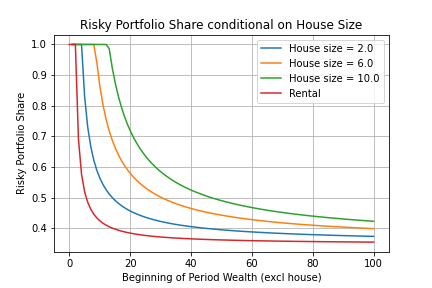
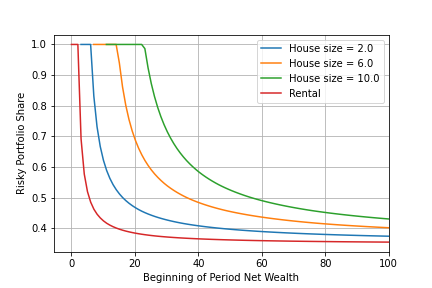
Figure 1 shows how the picture is modified for consumers who, in addition to their liquid
assets, own homes of various sizes.
According to the model, retired households who own their homes and expect to sell them by
next period have a higher risky share than retired households who rent, and their risky share
increases with house size, holding liquid wealth constant.
Clearly, the bigger the house size, the wealthier the agents are in terms of net worth. In the
standard portfolio choice model, wealthier households actually reduce their risky share
to reduce risk in next period’s consumption. In the presence of housing, however,
households still reduce their risk exposure as liquid wealth increases, but at a lower
rate.
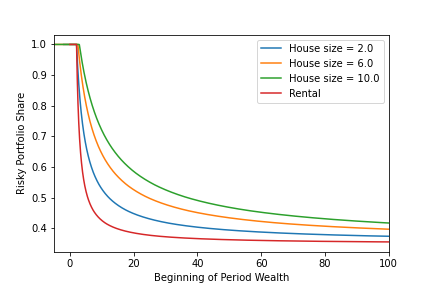
A better comparison is to add the expected value of the house to liquid wealth.
In this way, we compare an agent with  net worth with all liquid wealth
and no home, with an agent with
net worth with all liquid wealth
and no home, with an agent with  net worth, some of which is liquid wealth
 , and the rest is the illiquid expected house valuation
 ![𝔼[Q ]h](PortfolioChoiceWithRiskyHousing12x.svg) , such that
, such that
![w = m + 𝔼[Q ]h](PortfolioChoiceWithRiskyHousing13x.svg) , where
, where  denotes house prices and
  represents the size of the agent’s
house .
As we see in figure 2, the increase in the risky portfolio share is more significant when
considering home equity as part of net worth. Holding net wealth constant, households whose
wealth is tied up in an illiquid asset have more risk appetite the larger the proportion of home
equity to net wealth is.
represents the size of the agent’s
house .
As we see in figure 2, the increase in the risky portfolio share is more significant when
considering home equity as part of net worth. Holding net wealth constant, households whose
wealth is tied up in an illiquid asset have more risk appetite the larger the proportion of home
equity to net wealth is.
Additionally, an interesting observation is that according to the model retired households
who are about to sell their homes are willing to risk at least the full home equity (expected
value of their homes ![𝔼 [Q ]h](PortfolioChoiceWithRiskyHousing16x.svg) ) for certain when they have low liquidity. In other words, their
risky share is equal to 1 at least up to the point where their liquid wealth is equal to their
home equity. If we shift their liquid wealth leftward by the amount of their expected house
valuation, we see in figure 3 that their risky share starts dropping at about the same point as
it would if they rented a house instead. We can conclude that having a house shifts the
risky share curve rightward by an amount equal to the home equity, but this is
not the only effect. A larger house also reduces the rate at which the risky share
decreases.
) for certain when they have low liquidity. In other words, their
risky share is equal to 1 at least up to the point where their liquid wealth is equal to their
home equity. If we shift their liquid wealth leftward by the amount of their expected house
valuation, we see in figure 3 that their risky share starts dropping at about the same point as
it would if they rented a house instead. We can conclude that having a house shifts the
risky share curve rightward by an amount equal to the home equity, but this is
not the only effect. A larger house also reduces the rate at which the risky share
decreases.
5.2 Increasing house price risk decreases risky share
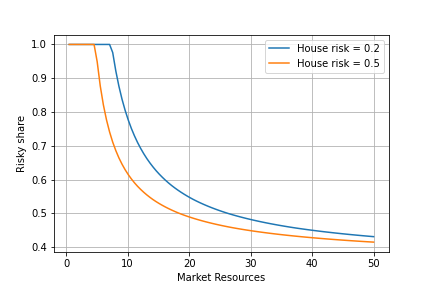
The volatility of the housing market can have strong implications for the portfolio decisions
of households who own their houses. A higher standard deviation in house prices implies a
larger implicit holding of a risky asset (the house), regardless of house size. For this reason,
households would optimally choose to avoid risk in other risky assets. As we see in figure 4 for
2 households who have a house of equal size, the risky share of a household in a more volatile
market is lower than that of a household in a less volatile market, except at low
levels of market resources. Households that experience high price volatility in the
housing market reduce their exposure to risk elsewhere, leading to lower risky portfolio
shares.
5.3 Larger houses increase households’ absolute risk taking
As mentioned before, a house represents an implicit holding in a risky market that is
otherwise uncorrelated with the stock market. A larger house, however, provides a higher
expected value of house liquidation which also means a higher expected future liquid wealth.
Households with more valuable homes, then, have a higher absolute risk tolerance because
their future housing value constitutes a buffer stock of wealth; thus they invest more
resources in the risky asset market than they would if they had smaller homes.
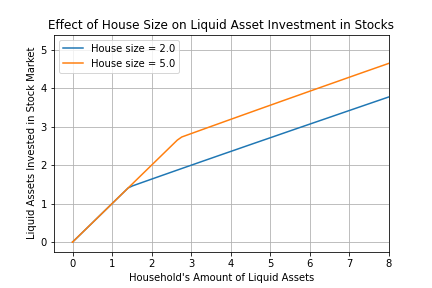
In figure 5 we see that for an initial level of liquid assets, households of different
house sizes invest the same amount of total assets in the stock market; this is the
region where their risky share is 100%. Past this region, we see that households
with a bigger house (and thus more home equity) are willing to invest a greater
share of their liquid assets than peers with the same amount of liquid assets but less
home equity. This indicates that home equity increases the level of risk appetite for
households.
5.4 House size crowds out investment
However, when comparing households on a total wealth basis, i.e. their liquid assets plus
expected house liquidation, we can see that house size crowds out investment for households
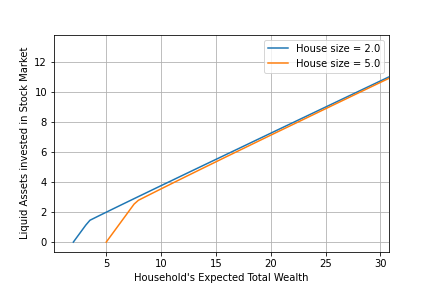
with low liquid wealth. In figure 6, we can consider a household whose house size is
equal to 5 (5 times their yearly net income) and liquid assets are 0, so their total
expected wealth is 5. As this household becomes wealthier, they invest all of their
liquid assets in the stock market (such that their risky share is 100 percent), up to
the point where they start rebalancing their portfolio between the risky and the
safe asset. In this region, they are constrained from investing in the stock market
by their low liquid wealth, as they surely would like to invest more in the market.
This point becomes clearer by comparing the household to an equally wealthy peer
with a smaller house. At the point where the household with house size of 5 has
liquid wealth of 1 (1 times their yearly net income), they are investing less into the
stock market in absolute terms than an equally wealthy household whose house size
is equal to 2 and liquid assets are equal to 4. The total expected wealth of both
these households is 6, but the household with the larger house is investing fewer
assets in the stock market than the household with the smaller house. As their total
wealth increases, however, both households are unconstrained by their house size
and end up investing about the same amount into the stock market in absolute
terms.
5.5 Optimal Portfolio Choice over the Lifecycle
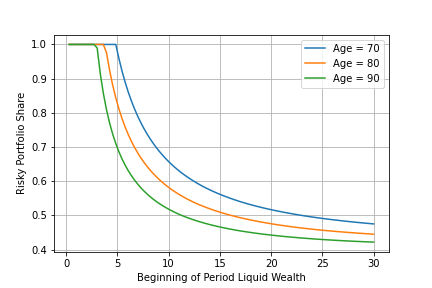
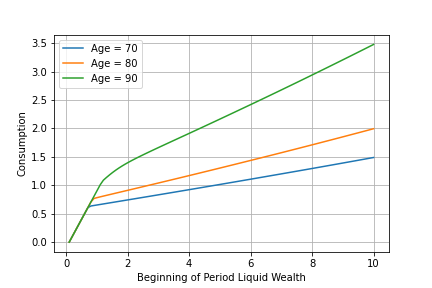
A result that is consistent with ConsPortfolioModel is that younger households have a higher
risky share of assets than older households, when comparing households of equal house size
and no mortgage debt. Similarly, older households consume more than younger households, as
their consumption horizon gets shorter and the likelihood that they receive a windfall of
wealth from their house liquidation increases.
6 Conclusions
Most people who need advice about how to invest in financial markets are also homeowners.
But until now, even the most sophisticated and realistic analyses of how people should
optimally invest in financial markets have not accounted for the (undeniably important)
ramifications of homeownership for their financial choices.
That’s because constructing a model that correctly tracks all the potential interactions
between homeownership, financial risk, and other kinds of risk is remarkably difficult. This
report describes a free, publicly available open-source software tool that does these complex
calculations. Sponsorship by the Think Forward Initiative has allowed us to add this tool to
the free, open-source, Econ-ARK toolkit, thus making it available to financial institutions,
financial planners, robo-advisors, academics, and anyone else who might be interested in a
rigorous analysis of these questions.
Despite their combinatorial complexity, the answers that come from the model make
intuitive sense. A first conclusion is that greater uncertainty about future house prices should
make you less willing to invest in the stock market. In other words, a homeowner who
lives in a place with wild house-price swings will find it best to have less exposure
to other kinds of risk (like stock market risk) than someone with circumstances
that are otherwise similar, but who lives in a place where house prices are more
stable.
Another conclusion might seem to push in the other direction, but really does not:
Among homeowners whose mortgage is paid off, for a given level of nonhousing net
worth (say, $200K of financial assets net of mortgage debt), a person whose house is
more valuable should invest more in risky financial asset. The reason is simple: For
a given amount of liquid assets, the person with a bigger house is richer, and a
richer person will want to have more money (in absolute terms) invested in the stock
market).
The final point is that the existence of homeownership does not reverse one of the more
surprising implications of the baseline model without homeownership: The richer you are, the
lower is the optimal share of your portfolio in risky assets. This implication of the model does
not match the available data well. The conclusion is easy to reverse by introducing a bequest
motive in which bequests are a luxury good; but how exactly such a motive should be
constructed is by no means a settled question, either among financial planners or
among academic researchers. It is a topic we hope to address in future releases of our
toolkit.
Appendices
A The base model
At date 0, the household finances the purchase of a house with a mortgage loan. Given
cash-on-hand at date 0  , which may come from previous savings or bequests, the
household simultaneously chooses a house size (among a set of discrete house sizes)
and a mortgage loan that meets the down-payment or Loan-to-Value requirement
, which may come from previous savings or bequests, the
household simultaneously chooses a house size (among a set of discrete house sizes)
and a mortgage loan that meets the down-payment or Loan-to-Value requirement
 , where
  is the proportional down-payment,
  is the unit-price of
housing, and
is the unit-price of
housing, and  is the chosen house size. An additional mortgage origination requirement
observed in the literature is the Loan-to-Income ratio
is the chosen house size. An additional mortgage origination requirement
observed in the literature is the Loan-to-Income ratio  , which reflects initial
mortgage affordability (Campbell and Cocco (2015)). Coincidentally, the household leaves
some cash-on-hand
, which reflects initial
mortgage affordability (Campbell and Cocco (2015)). Coincidentally, the household leaves
some cash-on-hand  to start next period with some liquidity.
![V0 (M0, P1) = Dm1a,xH1𝔼t [V1 (M1, H1,D1, P1 )]
s.t.
Q0H1+ M1 = M0 + D1
H ∈ ℍ = {h ,⋅⋅⋅,h }
1 1 n
D1 ≤ (1 − d)Q0H1 (LTV )
D1 ≤ λP1 (LTI )](PortfolioChoiceWithRiskyHousing24x.svg) | (1) |
A.1 Fixed-Rate Mortgage payments
When a household chooses a house size and mortgage loan, they also commit to a fixed
payment amount and a loan duration of, for example, 30 years. To calculate the fixed rate
mortgage payment ( ), we can start with the amount owed at the beginning of each
period
), we can start with the amount owed at the beginning of each
period  and subtract a fixed payment, which is then multiplied by a fixed mortgage
interest rate
and subtract a fixed payment, which is then multiplied by a fixed mortgage
interest rate  . The limiting condition that ensures repayment at time
  is
is  ,
which leads to
,
which leads to  as shown below:
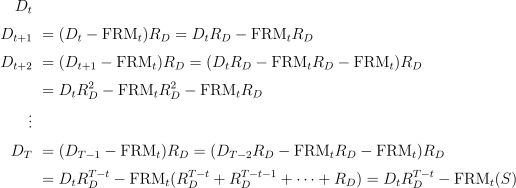 | (2) |
where 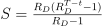 . Setting
  as a repayment requirement, the fixed rate
mortgage payment is
as a repayment requirement, the fixed rate
mortgage payment is
 | (3) |
The household is allowed to pay more than its required mortgage payment, which in this
model leads to a decrease in the future minimum required payment  to maintain
the mortgage duration. If the household continually pays more than the minimum
payment,
to maintain
the mortgage duration. If the household continually pays more than the minimum
payment,  becomes
  when the mortgage debt is fully paid off. This flexibility
allows for the fixed rate mortgage payment to depend only on current mortgage debt
when the mortgage debt is fully paid off. This flexibility
allows for the fixed rate mortgage payment to depend only on current mortgage debt
 and time to mortgage maturity, which is tracked by the age of the household
 .
.
A.2 The Investor’s problem in the presence of housing risk
A.2.1 Investing before Retirement
A working household begins period  with cash-on-hand
  , housing size
  ,
mortgage debt
,
mortgage debt  , and permanent income
  . It must then choose a level of consumption
 , mortgage payment
  , and savings
  of which a fraction
  is invested into a risky
asset and the rest into a safe asset.
is invested into a risky
asset and the rest into a safe asset.
The mortgage payment must be at least the fixed rate mortgage payment  in
order to ensure payoff within an expected maturity of
in
order to ensure payoff within an expected maturity of  years.
Although the model does not allow for explicit choices over housing adjustments, the
household must nevertheless pay maintenance and upkeep costs due to housing depreciation at
a cost of  . Additionally, the household must also exogenously expand or contract their
housing size given a life-cycle path of housing size
. Additionally, the household must also exogenously expand or contract their
housing size given a life-cycle path of housing size  . This parameter is intended to
represent the observed path of the housing size component of portfolio compositions over the
life-cycle.
. This parameter is intended to
represent the observed path of the housing size component of portfolio compositions over the
life-cycle.
![Vt (Mt, Ht, Dt,Pt ) = mAatx,It,ςtu(Ct,Ht ) + β 𝔼t[Vt+1(Mt+1, Ht+1, Dt+1,Pt+1)]
s.t.
At = Mt − Ct − It
At ≥ 0
It ≥ FRMt + [Ht+1 − (1 − δ)Ht]Q0
Pt+1 = Γ t+1Pt
Yt+1 = 𝜃t+1Pt+1
M = Y + A (ςR + (1 − ς )R)
t+1 t+1 t t t+1 t
Ht+1 = Γ Ht+1Ht
Dt+1 = RD (Dt − It)](PortfolioChoiceWithRiskyHousing53x.svg) | (4) |
A.2.2 Investing after Retirement
Households deterministically retire at age  , and begin to experience exogenous risk of
housing liquidation. By this time, the household has finished paying their mortgage debt, and
so we lose the
, and begin to experience exogenous risk of
housing liquidation. By this time, the household has finished paying their mortgage debt, and
so we lose the  state variable. If the household is exogenously forced to liquidate
their house, they receive their home equity at the beginning of next period and
become renters until death. The problem of a household which faces housing risk
is
state variable. If the household is exogenously forced to liquidate
their house, they receive their home equity at the beginning of next period and
become renters until death. The problem of a household which faces housing risk
is
![VHt (Mt, Ht, Pt) = max u (Ct,Ht) + βst 𝔼t[VHt+1(Mt+1, Ht+1,Pt+1)]
Ct,At,ςt
+ β(1 − st)𝔼t[VR (M R ,Pt+1)]
t+1 t+1
s.t.
At = Mt − Ct − It, At ≥ 0
It ≥ [Ht+1 − (1 − δ)Ht]Q0
Pt+1 = Γ t+1Pt
Yt+1 = 𝜃t+1Pt+1
Mt+1 = Yt+1 + At(ςtRt+1 + (1 − ςt)R)
R
M t+1 = Mt+1 + Qt+1Ht+1
H = Γ H H
t+1 t+1 t](PortfolioChoiceWithRiskyHousing56x.svg) | (5) |
The renter’s problem then becomes a simple portfolio problem where the household
additionally pays for rental housing.
![VR (M ,P ) = max u (C ,HR ) + β 𝔼 [VR (M ,P )]
t t t Ct,HRt ,At,ςt t t t t+1 t+1 t+1
s.t.
R R
At = Mt − Ct − H t , Ct,H t ,At ≥ 0
M = Y + A (ςR + (1 − ς )R)
t+1 t+1 t t t+1 t
Pt+1 = Γ t+1Pt
Yt+1 = 𝜃t+1Pt+1](PortfolioChoiceWithRiskyHousing57x.svg) | (6) |
B Normalization
A useful strategy to facilitate finding the solution of these types of problems is normalization
by permanent income. Throughout this section we assume
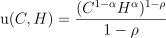 | (7) |
which is a Cobb-Douglas function nested inside a CRRA utility function. The model
parameter  determines the relative preference between non-durable consumption and
housing size. In a simple rental housing problem, it also determines directly the rental housing
share of total expenditures, as we’ll see below.
determines the relative preference between non-durable consumption and
housing size. In a simple rental housing problem, it also determines directly the rental housing
share of total expenditures, as we’ll see below.
B.1 Rental Housing in the Utility
A renter pays for rental housing every period until death. Rental housing enters the utility as
a non-durable expenditure and, like consumption, it has no impact on the continuation
value. Using the utility function described above, and representing non-durable
total expenditures as  , utility maximization implies that
  ,
,
 , and
, and  . Substituting these results into the utility function, it
becomes:
. Substituting these results into the utility function, it
becomes:
 | (8) |
Thus, we can represent the problem of total expenditures between consumption and rental
housing as  , where
  is a CRRA utility function with
  coefficient.
B.2 The Retired Renter’s last period of life
In the last period of life, a renter has no need to save and thus has to decide to
spend all of his cash-on-hand ( ) between non-durable consumption and rental
housing.
) between non-durable consumption and rental
housing.
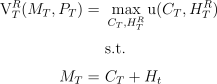 | (9) |
Again, utility maximization implies that  and
and  . Substituting into
the previous equation we obtain:
. Substituting into
the previous equation we obtain:
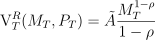 | (10) |
where  . We can now normalize by permanent income
  such that
lowercase variables are
such that
lowercase variables are  . Substituting
  , the expression
becomes
, the expression
becomes
 | (11) |
If we define a normalized equation as 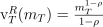 then the original problem can be
rewritten as
then the original problem can be
rewritten as
 | (12) |
B.3 The Retired Renter’s second-to-last period
We can now consider the second-to-last period, although the same analysis will apply
recursively to any period with a non-zero continuation value. Normalizing as above, where
 , we obtain
![VRT− 1(MT −1,PT− 1) = maxR u (CT −1,HT − 1) + β 𝔼t[VRT (MT ,PT )]
CT−1,HT−1,ςT−1
= max A˜u (x P ) + β 𝔼 [P1− ρΓ 1−ρ˜AvR (m )]
xT−1,ςT−1 T −1 T− 1 t T− 1 T T T
{ }
= A˜P T1−− ρ1 max u(xT− 1) + β 𝔼t[Γ 1T−ρvRT (mT )]
xT−1,ςT−1](PortfolioChoiceWithRiskyHousing81x.svg) | (13) |
We can again define the normalized value function as  and re-write
the problem as
and re-write
the problem as
![vRT−1(mT −1) = max u(xT −1) + β 𝔼t [Γ 1−T ρvRT(mT )]
xT−1,ςT−1](PortfolioChoiceWithRiskyHousing83x.svg) | (14) |
The generalized renter’s problem with non-zero continuation value then simplifies to a
simple consumption and portfolio choice problem with additionally defined control variables as
presented below.
![R 1−ρ R
vt (mt ) = maxxt,ςt u(xt) + β 𝔼t[Γ t+1 vt+1 (mt+1)]
s.t.
at = mt − xt, xt,at ≥ 0
ct = (1 − α)xt,
ht = αxt
mt+1 = 𝜃t+1 + at(ςtRt+1 + (1 − ςt)R )∕Γ t+1](PortfolioChoiceWithRiskyHousing84x.svg) | (15) |
B.4 The Retired Homeowner’s last period of life
We assume homeowners deterministically become renters before their last period of
life.
B.5 The Retired Homeowner’s second-to-last period of life
In their second-to-last period of life, a homeowner will become a renter in the next period with
certainty. Note that by this stage of life the household has no outstanding mortgage debt.
Their problem is
![VHT−1(MT −1,HT − 1,PT −1) = max u(CT− 1,HT −1) + β 𝔼t[VRT(M RT ,PT)]
CT−1,AT−1,ςT−1
s.t.
CT −1 + AT −1 = MT −1 − [Γ HT−1 − (1 − δ )]Q0HT −1, CT −1,AT −1 ≥ 0
R H
M T = YT + AT− 1(ςT− 1RT + (1 − ςT−1)R ) + QT Γ T−1HT −1
PT = Γ TPT− 1
YT = 𝜃T PT](PortfolioChoiceWithRiskyHousing85x.svg) | (16) |
A similar normalization procedure as above yields the following equivalent problem
![vH (m ,h ) = max u(c ,h ) + A˜β 𝔼[Γ 1−ρvR (mR )]
T−1 T− 1 T−1 cT−1,aT− 1,ςT− 1 T−1 T −1 T T T
s.t.
H
cT −1 + aT−1 = mT − 1 − [ΓT− 1 − (1 − δ)]Q0hT −1, cT− 1,aT−1 ≥ 0
mR = 𝜃T + aT −1(ςT −1RT + (1 − ςT−1)R )∕Γ T + QT Γ H hT− 1∕ Γ T
T T−1](PortfolioChoiceWithRiskyHousing86x.svg) | (17) |
B.6 The Retired Homeowner’s general problem
A retired homeowner has no mortgage debt or payments, but does experience house
liquidation and house price risk. With probability  , the homeowner will be forced to
sell their house and become a renter next period, in which case they obtain the value of their
home as a liquid asset.
, the homeowner will be forced to
sell their house and become a renter next period, in which case they obtain the value of their
home as a liquid asset.
![VH (M ,H ,P ) = max u (C ,H ) + βs 𝔼 [VH (M ,H ,P )]
t t t t Ct,At,ςt t t t t t+1 t+1 t+1 t+1
R R
+ β(1 − st)𝔼t[Vt+1(M t+1,Pt+1)]
s.t.
Ct + At = Mt − [Ht+1 − (1 − δ)Ht ]Q0, Ct, At ≥ 0
Mt+1 = Yt+1 + At(ςtRt+1 + (1 − ςt)R)
R
M t+1 = Mt+1 + Qt+1Ht+1
H
Ht+1 = Γt+1Ht
Pt+1 = Γ t+1Pt
Yt+1 = 𝜃t+1Pt+1](PortfolioChoiceWithRiskyHousing88x.svg) | (18) |
The normalized version of their problem is
![H [ 1−ρ ( H ˜ R R ) ]
vt (mt,ht) = mcat,xat,ςtu(ct,ht) + β 𝔼t Γt+1 stvt+1(mt+1,ht+1) + (1 − st)Av t+1(m t+1 )
s.t.
H
ct + at = mt − [Γ t+1 − (1 − δ)]Q0ht, ct,at ≥ 0
m = 𝜃 + a (ςR + (1 − ς )R)∕Γ , 0 ≤ ς ≤ 1
t+1 t+1 t t t+1 t t+1 t
ht+1 = Γ Ht+1ht ∕Γ t+1
mRt+1 = mt+1 + Qt+1ht+1](PortfolioChoiceWithRiskyHousing89x.svg) | (19) |
B.7 The Working Homeowner that has mortgage debt
B.8 The borrowing constraint
Every household arrives at the last period of the model as a retired renter. Because they will
die with certainty by the end of the period, there is a strict no-borrowing constraint imposed
for these households ( ). This implies that the minimum allowable level of market
resources is also
). This implies that the minimum allowable level of market
resources is also  . If the household arrived to the last period with a negative
level of market resources, it would have to consume a negative amount, yielding
. If the household arrived to the last period with a negative
level of market resources, it would have to consume a negative amount, yielding  utility.
This strict borrowing constraint in the last period leads to a self imposed borrowing
constraint in the second to last period, as the precautionary savings motive induces households
to meet a minimum allowable level of market resources next period in order to avoid  utility.
For the retired renter household, that means
 | (20) |
Because renting households have no collateral (a home), we can assume an artificial
no-borrowing constraint. The minimum allowable level of market resources next period is met
as long as  , which is true by construction. The no-borrowing constraint, in turn,
induces a minimum allowable level of market resources in the second to last period as
, which is true by construction. The no-borrowing constraint, in turn,
induces a minimum allowable level of market resources in the second to last period as
 . Recursively, we can continue to assume a no-borrowing constraint for every period
imposed on the retired renter household, which implies
. Recursively, we can continue to assume a no-borrowing constraint for every period
imposed on the retired renter household, which implies  and
and  for all
  during retirement.
The retired homeowner in their second to last period will become a renter with certainty
by the next period, at which point they receive the cash value of their liquidated
house.
 | (21) |
which implies a natural minimum allowable level of market resources for homeowners
of
 | (22) |
The last period market resources for homeowners is ruled by the transition equation
 | (23) |
Given a household’s decision on asset level  , the lowest possible realization of next
period market resources occurs when the household receives the lowest possible return, along
with the lowest realizations of income shocks next period. For each
, the lowest possible realization of next
period market resources occurs when the household receives the lowest possible return, along
with the lowest realizations of income shocks next period. For each  , then, there is an
upper bound on the risky share
, then, there is an
upper bound on the risky share  such that the minimum allowable level of future market
resources is met.
such that the minimum allowable level of future market
resources is met.
 | (24) |
which implies a natural risky share constraint of
 | (25) |
The natural borrowing constraint, then, occurs when the implied natural risky share
constraint is  , which is
 | (26) |
The minimum allowable level of market resources constraint is once again derived from the
precautionary motive  , which results in
![H
mT −1(hT− 1) = aT −1(hT−1) + [ΓT−1 − (1 − δ)]Q0hT −1.](PortfolioChoiceWithRiskyHousing111x.svg) | (27) |
An important issue arises in the third-to-last period. Households who will become renters
next period only have to meet the minimum allowable level of market resources for rental
households next period  or equivalently
  . Households
who will remain homeowners instead have to meet the minimum allowable level of market
resources for home-owning households next period (determined above). However, unlike in
the second-to-last period, households in the third-to-last period do not know what
type they will be in the next period, so they must meet both constraints, and thus
must meet the stricter constraint. The effective minimum allowable level of market
resources for the second to-last-period
. Households
who will remain homeowners instead have to meet the minimum allowable level of market
resources for home-owning households next period (determined above). However, unlike in
the second-to-last period, households in the third-to-last period do not know what
type they will be in the next period, so they must meet both constraints, and thus
must meet the stricter constraint. The effective minimum allowable level of market
resources for the second to-last-period  and recursively for periods before it
is:
and recursively for periods before it
is:
![m-∗t(ht) = max {at(ht) + [Γ Ht − (1 − δ)]Q0ht,− Qtht}](PortfolioChoiceWithRiskyHousing115x.svg) | (28) |
and the general natural borrowing constraint for period  and recursively for every
period before it is
and recursively for every
period before it is
 | (29) |
C Backsolving the problem
The overall return on the consumer’s portfolio is
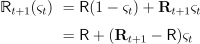 | (30) |
The first order condition with respect to  is
is
![[ −ρ ( ) ]
u ′1(ct,ht) = β 𝔼t Γ t+1Rt+1 st∂mvHt+1(mt+1, ht+1 ) + (1 − st) ˜A∂mvRt+1(mRt+1)](PortfolioChoiceWithRiskyHousing120x.svg) | (31) |
The first order condition with respect to  is
is
![[ ( )]
0 = β 𝔼 Γ −ρ(R − R) s ∂ vH (m ,h ) + (1 − s ) ˜A ∂ vR (mR ) a
t t+1 t+1 t m t+1 t+1 t+1 t m t+1 t+1 t](PortfolioChoiceWithRiskyHousing122x.svg) | (32) |
A useful function to define is
![[ 1−ρ ( H R R ) ]
𝔳t(at,ςt) = β 𝔼t Γt+1 stvt+1 (mt+1, ht+1) + (1 − st)A˜v t+1(m t+1)](PortfolioChoiceWithRiskyHousing123x.svg) | (33) |
with first order conditions
which implies first order conditions for the problem
We can define the problem
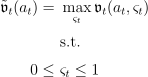 | (38) |
which leads to solution
 | (39) |
we can solve for consumption function as
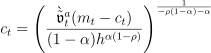 | (40) |
Similarly, as before, the Envelope condition is
 | (41) |
D Portfolio Choice after retirement
D.1 The solution of risky share
Let  be log-normally distributed such that
  , then it is true
that
, then it is true
that
![𝔼 [R ] = er+σ2r∕2 and Var [R ] = (eσ2r − 1)e2r+ σr2
t t+1 t t+1](PortfolioChoiceWithRiskyHousing132x.svg) | (42) |
Thus, if we want to produce a log-normal distribution with mean  and variance
  , we
can use a normal distribution with
, we
can use a normal distribution with
 | (43) |
According to Campbell and Viceira, the optimal share of stocks in financial wealth for an
agent that is not facing income uncertainty is
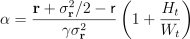 | (44) |
Using the above relations, we know that
 | (45) |
D.2 Exogenous Risky Share
Given the solution of portfolio choice after retirement, if we want to target a particular risky
share  (for example, one that fits the observed data on portfolio choice after retirement), we
can back out the agent’s beliefs on the risky asset return that would rationalize such an
(for example, one that fits the observed data on portfolio choice after retirement), we
can back out the agent’s beliefs on the risky asset return that would rationalize such an  .
Assuming we know an agent’s financial wealth (human and non-human), we can fix
.
Assuming we know an agent’s financial wealth (human and non-human), we can fix  to find an ex-ante belief on the variance of the risky distribution that rationalizes an
exogenous risky share
to find an ex-ante belief on the variance of the risky distribution that rationalizes an
exogenous risky share  as
as
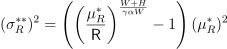 | (46) |
Fixing  and finding a
  that rationalizes an exogenous risky share
  has no analytical solution, although a numerical solution might exist under some
conditions.
has no analytical solution, although a numerical solution might exist under some
conditions.
Of course, if instead we fix  or
or  , we can obtain rationalized
beliefs as
, we can obtain rationalized
beliefs as
 | (47) |
and
 | (48) |
It’s important to note that these beliefs will result in different risky distribution parameters
than those that pegged the log-normal distribution parameter.
E The Portfolio Choice Problem for Rental Households
Households that do not own and instead rent their homes have to decide how much to
consume, how much to spend on rent, and how much to save. Their normalized problem can
be stated as:
![[ ]
wt(mt) = max u(ct,ht) + β 𝔼t Γ 1−t+1ρwt+1(mt+1 )
{at,ht,ςt}
s.t.
at = mt − ct − ht
Rt+1(ςt) = R + (Rt+1 − R)ςt
mt+1 = atRt+1 (ςt)∕Γ t+1 + 𝜃t+1](PortfolioChoiceWithRiskyHousing150x.svg) | (49) |
Consider the problem of a consumer that has  to spend on consumption and housing.
Their problem is
to spend on consumption and housing.
Their problem is
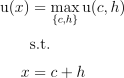 | (50) |
Given the functional form of utility we are using (CRRA with paramter  ), the well known
solution to this simple problem is
), the well known
solution to this simple problem is  and
and  . Restating the problem in
terms of
. Restating the problem in
terms of  , we obtain:
 | (51) |
where  . Because both consumption and housing are non-durable in
the case of a rental household, the consumer can first decide how much to spend on both
goods (
. Because both consumption and housing are non-durable in
the case of a rental household, the consumer can first decide how much to spend on both
goods ( ) and then decide how much to spend on each of the goods without changing the
problem. A further step to simplify the problem is to use iterated expectations to split up the
problem into subperiods. We can define
) and then decide how much to spend on each of the goods without changing the
problem. A further step to simplify the problem is to use iterated expectations to split up the
problem into subperiods. We can define
![[ 1−ρ ]
wt (bt+1) = 𝔼t Γt+1wt+1(mt+1 )
where
mt+1 = bt+1∕Γ t+1 + 𝜃t+1](PortfolioChoiceWithRiskyHousing160x.svg) | (52) |
Now, we can rewrite our original problem as
![wt(mt ) = m{aatx,ςt}u(xt) + β 𝔼t [wt(bt+1)]
s.t.
at = mt − xt
R (ς ) = R + (R − R )ς
t+1 t t+1 t
bt+1 = atRt+1(ςt)](PortfolioChoiceWithRiskyHousing161x.svg) | (53) |
which embeds the simple subproblem and our defined iterated expectation.
We can rewrite the problem as
![wt (mt) = m{aaxt,ςt}u (mt − at) + β 𝔼t [wt (at(R + (Rt+1 − R )ςt))]](PortfolioChoiceWithRiskyHousing162x.svg) | (54) |
First order condition with respect to  provides the Euler equation
![u′(x ) = β 𝔼 [w ′(b )R (ς )]
t t t t+1 t+1 t](PortfolioChoiceWithRiskyHousing164x.svg) | (55) |
and the first order condition with respect to  is
is
![′
β 𝔼t [wt(bt+1)at(Rt+1 − R )] = 0](PortfolioChoiceWithRiskyHousing166x.svg) | (56) |
The envelope condition is given by
 | (57) |
And finally,
![w ′(bt+1) = 𝔼t [Γ 1−ρw ′ (mt+1 )∕Γ t+1] = 𝔼t [Γ −ρ w ′ (mt+1 )]
t t+1 t+1 t+1 t+1](PortfolioChoiceWithRiskyHousing168x.svg) | (58) |
F The portfolio problem of a homeowner with no mortgage
A homeowner with no mortgage debt is allowed to invest more on their house to increase its
size (or they can let it depreciate). In doing so, they choose home investment, consumption,
and savings. Their problem is summarized as follows:
![[ 1−ρ( w )]
vt(mt, ht−1) = maat,xςt,itu(ct,ht) + β 𝔼t Γt+1 (1 − 𝜗 )vt+1(mt+1, ht+1) + 𝜗wt+1(m t+1)
s.t.
ht = (1 − δ)ht−1 + it∕ ϙ0
ht+1 = ht∕ Γ t+1
at = mt − ct − it
Rt+1(ςt) = R + (Rt+1 − R)ςt
mt+1 = atRt+1 (ςt)∕Γ t+1 + 𝜃t+1
mw = mt+1 + ϙ ht+1
t+1 t+1](PortfolioChoiceWithRiskyHousing169x.svg) | (59) |
To facilitate the solution method, we can split the above problem into different
subperiods.
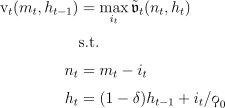
In the first subperiod, the household arrives with cash on hand and their previous housing
size. They then pick their current size by investing  where housing costs are
  . After
investing, they are left with net cash on hand after housing costs, and a new housing
size.
. After
investing, they are left with net cash on hand after housing costs, and a new housing
size.
 | (60) |
In the second subperiod, the household arrives with net cash on hand and their current
housing size. This subperiod is a standard portfolio choice problem, indexed by their house
size. The agent must then choose a level of savings  and the proportion of their savings
that will go into the risky asset
and the proportion of their savings
that will go into the risky asset  versus the safe asset
  .
.
![[ ]
˜𝔳t(nt,ht) = max u (ct,ht) + β 𝔼t `˜𝔳t(bt+1, ht)
{at,ςt}
at = nt − ct
R (ς) = R + (R − R)ς
t+1 t t+1 t
bt+1 = atRt+1(ςt)](PortfolioChoiceWithRiskyHousing176x.svg) | (61) |
Finally in the last subperiod, the household’s uncertainty is realized. Simultaneously, they
observe their permanent and transitory income shocks, whether they will become renters in
the next period (function  with probability
  ), and if they do become renters, the
liquidation price of their house per unit of housing.
), and if they do become renters, the
liquidation price of their house per unit of housing.
![`˜ [ 1−ρ( w )]
𝔳t(bt+1,ht) = 𝔼t Γ t+1 (1 − 𝜗)vt+1(mt+1, ht+1) + 𝜗wt+1 (m t+1 )
where
ht+1 = ht∕Γ t+1
mt+1 = bt+1 ∕Γ t+1 + 𝜃t+1
w
m t+1 = mt+1 + ht+1ϙt+1](PortfolioChoiceWithRiskyHousing179x.svg) | (62) |
F.1 First order conditions: Choosing home investment
The problem is
 | (63) |
The first order condition with respect to  is
is
 | (64) |
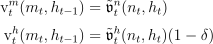
which equalizes the marginal benefit of additional net cash-on-hand (cash-on-hand net of
home investment) with the marginal cost of a larger house. The envelope conditions
are
 | (65) |
F.2 First order conditions: Choosing consumption and portfolio investment
Once again, let’s reduce the problem to 1 line.
![[ ]
˜𝔳 (n ,h ) = max u(n − a ,h) + β 𝔼 `˜𝔳(a (R + (R − R)ς),h )
t t t {at,ςt} t t t t t t t+1 t t](PortfolioChoiceWithRiskyHousing184x.svg) | (66) |
Notice that  passes through this problem unaltered. Indeed, in this subproblem, the
house size indexes the portfolio choice (and may affect marginal utility) but does not need
further addressing beyond a simple portfolio choice model.
passes through this problem unaltered. Indeed, in this subproblem, the
house size indexes the portfolio choice (and may affect marginal utility) but does not need
further addressing beyond a simple portfolio choice model.
The first order condition with respect to  is
is
![[ ]
uc(c,h ) = β 𝔼 `˜𝔳b(b ,h )R (ς )
t t t t t+1 t t+1 t](PortfolioChoiceWithRiskyHousing187x.svg) | (67) |
The first order condition with respect to  is
is
![[ b ]
β 𝔼t `˜𝔳t(bt+1,ht)at(Rt+1 − R) = 0](PortfolioChoiceWithRiskyHousing189x.svg) | (68) |
Finally, the envelope conditions are
![˜𝔳nt (nt,ht) = uc(ct,ht)
h h [ h ]
˜𝔳 t(nt,ht) = u (ct,ht) + β 𝔼t `˜𝔳t(bt+1,ht)](PortfolioChoiceWithRiskyHousing190x.svg) | (69) |
The second envelope condition is due to the nature of the  pass-through.
F.3 Envelope conditions: Uncertainty is realized
The last subperiod is harder to re-write in one line, but because there is no maximization it is
straight forward to calculate the derivatives.
![`˜b [ −ρ ( m m w )]
𝔳t(bt+1,ht) = 𝔼t [Γt+1((1 − 𝜗)vt+1(mt+1, ht+1) + 𝜗w t+1(m t+1) )]
`˜𝔳h(bt+1,ht) = 𝔼t Γ −ρ (1 − 𝜗)vh (mt+1, ht+1) + 𝜗wm (mw )ϙ
t t+1 t+1 t+1 t+1 t+1](PortfolioChoiceWithRiskyHousing192x.svg) | (70) |
G Solving the homeowner with mortgage problem
![v (m ,h ,d ) = max u(c ,h ) + β 𝔼 [Γ 1−ρv (m ,h ,d )]
t t t t−1 at,ςt,it t t t t+1 t+1 t+1 t+1 t+1
s.t.
d = d + (1 − δ)h − i
t t−1 t t
at = mt − ct − it
Rt+1 (ςt) = R + (Rt+1 − R )ςt
mt+1 = atRt+1(ςt)∕Γ t+1 + 𝜃t+1
h = h ∕Γ
t+1 t t+1
mwt+1 = mt+1 + ϙt+1ht+1](PortfolioChoiceWithRiskyHousing193x.svg) | (71) |
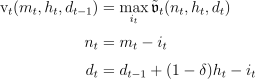
Can also be split up into subparts
 | (72) |
![[ ]
`
˜𝔳t(nt,ht,dt) = {maat,xςt}u (ct,ht) + β 𝔼t ˜𝔳t(bt+1, ht,dt)
at = nt − ct
Rt+1(ςt) = R + (Rt+1 − R)ςt
b = a R (ς )
t+1 t t+1 t](PortfolioChoiceWithRiskyHousing195x.svg) | (73) |
![`˜ [ 1−ρ ]
𝔳t(bt+1,ht,dt) = 𝔼t Γt+1vt+1(mt+1,ht+1,dt+1)
where
ht+1 = ht∕Γ t+1
dt+1 = dtRD ∕Γ t+1
mt+1 = bt+1∕Γ t+1 + 𝜃t+1
mw = m + h ϙ
t+1 t+1 t+1 t+1](PortfolioChoiceWithRiskyHousing196x.svg) | (74) |
References
Brandsaas, Eirik (2018): “Household Stock Market Participation: The Role of
Homeownership,” SSRN Electronic Journal.
Campbell, John Y., and João F. Cocco (2003): “Household risk
management and optimal mortgage choice,” Quarterly Journal of Economics, 118(4),
1449–1494.
__________ (2015): “A Model of Mortgage Default,” Journal of Finance, 70(4),
1495–1554.
Carroll, Christopher (2020): “Optimal Financial
Investments Over the Life Cycle,” Think Forward Initiative,
(https://www.thinkforwardinitiative.com/stories/optimal-financial-investments-over-the-life-cycle).
CHETTY, RAJ, LÁSZLÓ SÁNDOR, and ADAM SZEIDL (2017): “The
Effect of Housing on Portfolio Choice,” The Journal of Finance, 72(3), 1171–1212.
Cocco, João F. (2005): “Portfolio choice in the presence of housing,” Review of
Financial Studies, 18(2), 535–567.
Cocco, João F., F. J. Gomes, and Pascal J. Maenhout (2005):
“Consumption and portfolio choice over the life cycle,” Review of Financial Studies,
18(2), 491–533.
Gomes, Francisco (2020): “Portfolio Choice over the Life Cycle: A Survey,”
Annual Review of Financial Economics, 12(1), 277–304.
Gomes, Francisco, and Alexander Michaelides (2005): “Optimal life-cycle
asset allocation: Understanding the empirical evidence,” Journal of Finance, 60(2),
869–904.
Merton, Robert C. (1969): “Lifetime Portfolio Selection under Uncertainty: The
Continuous-Time Case,” The Review of Economics and Statistics, 51(3), 247.
Paz-Pardo, Gonzalo (2021): “Homeownership and Portfolio Choice over the
Generations,” Ssrn, pp. 1–87.
Samuelson, Paul A. (1969): “Lifetime Portfolio Selection By Dynamic Stochastic
Programming,” The Review of Economics and Statistics, 51(3), 239.
Yao, Rui, and Harold H. Zhang (2005): “Optimal consumption and portfolio
choices with risky housing and borrowing constraints,” Review of Financial Studies,
18(1), 197–239.
![[ ( )]
𝔳a = β 𝔼t Γ − ρRt+1 st∂mvH (mt+1, ht+1) + (1 − st)A˜∂mvR (mR ) (34)
t [ t+1 (t+1 t+1 t+1 ) ]
𝔳 ς = β 𝔼 Γ − ρ(R − R ) s ∂ vH (m ,h ) + (1 − s )A ˜∂ vR (mR ) a(35)
t t t+1 t+1 t m t+1 t+1 t+1 t m t+1 t+1 t](PortfolioChoiceWithRiskyHousing124x.svg)
