 Powered by Econ-ARK
# Some initial setup
from HARK.ConsumptionSaving.ConsIndShockModel import PerfForesightConsumerType
import statsmodels.formula.api as sm
import scipy.stats as stats
import datetime as dt
import pandas as pd
from matplotlib import pyplot as plt
import numpy as np
plt.style.use("seaborn-v0_8-darkgrid")
plt.rcParams["font.family"] = "DejaVu Sans" # ships with matplotlib, so saved figures match on every OS
palette = plt.get_cmap("Dark2")
from pathlib import Path
# Figures are saved beside this notebook, in a folder named after it
figures_dir = Path("KeynesFriedmanModigliani")
figures_dir.mkdir(exist_ok=True)
def save_figure(name):
"""Save the current figure as figures_dir/<name>.png (web) and .pdf (LaTeX)."""
plt.savefig(figures_dir / f"{name}.png", bbox_inches="tight", metadata={"Software": None})
plt.savefig(figures_dir / f"{name}.pdf", bbox_inches="tight", metadata={"CreationDate": None})1. The Keynesian consumption function
Keynes:
“The amount of aggregate consumption mainly depends on the amount of aggregate income.”
It is a “fundamental psychological rule ... that when ... real income increases ... consumption [will increase], but by less than the increase in income.”
More generally, “as a rule, a greater proportion of income ... is saved as real income increases.”
This can be formalized as:
for
The Keynesian Consumption Function
class KeynesianConsumer:
    """
    This class represents consumers that behave according to a
    Keynesian consumption function, representing them as a
    special case of HARK's PerfForesightConsumerType

    Methods:
    - cFunc: computes consumption/permanent income
             given total income/permanent income.
    """

    def __init__(self):
        Keynesian = (
            PerfForesightConsumerType()
        )  # set up a consumer type and use default parameters
        Keynesian.cycles = 0  # Make this type have an infinite horizon
        Keynesian.DiscFac = 0.05
        Keynesian.PermGroFac = [0.7]

        Keynesian.solve()  # solve the consumer's problem
        Keynesian.unpack("cFunc")  # unpack the consumption function

        self.cFunc = Keynesian.solution[0].cFunc
        self.a0 = self.cFunc(0)
        self.a1 = self.cFunc(1) - self.cFunc(0)
# Plot cFunc(Y)=Y against the Keynesian consumption function
# Deaton-Friedman consumption function is a special case of perfect foresight model
# We first create a Keynesian consumer
KeynesianExample = KeynesianConsumer()
# and then plot its consumption function
income = np.linspace(0, 30, 20) # pick some income points
plt.figure(figsize=(9, 6))
plt.plot(
income, KeynesianExample.cFunc(income), label="Consumption function"
) # plot income versus the consumption
plt.plot(income, income, "k--", label="C=Y")
plt.title("Consumption function")
plt.xlabel("Income (y)")
plt.ylabel("Normalized Consumption (c)")
plt.ylim(0, 20)
plt.legend()
save_figure("keynesian-consumption-function")
plt.show()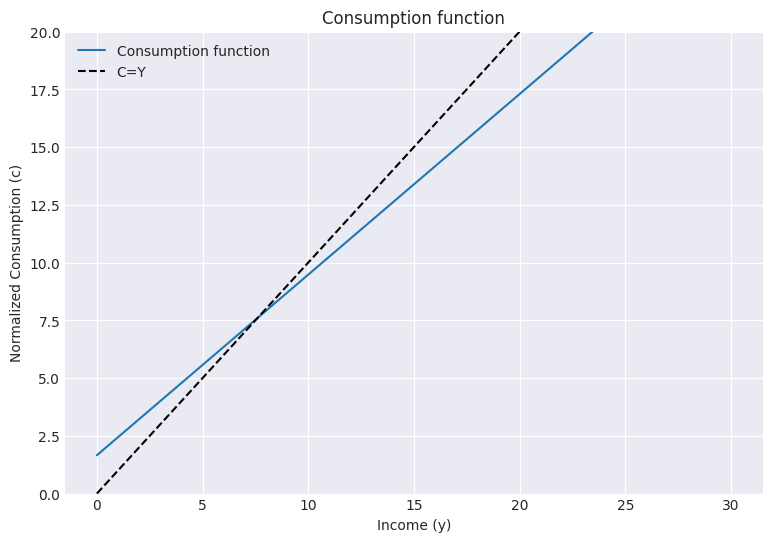
# This looks like the first of the two equations, consumption as a linear function of income!
# This means that even in a microfounded model (that HARK provides), the consumption function can match Keynes reduced form
# prediction (given the right parameterization).

# We can even find a_0 and a_1
a_0 = KeynesianExample.a0
a_1 = KeynesianExample.a1
print("a_0 is {:.2f}".format(a_0))
print("a_1 is {:.2f}".format(a_1))
a_0 is 1.66
a_1 is 0.78
The Keynesian consumption function: Evidence
Aggregate Data:
Long-term time-series estimates: close to zero, close to 1 (saving rate stable over time - Kuznets).
Short-term aggregate time-series estimates of change in consumption on change in income find .
finds significant , near 1.
# Let's have a look at some aggregate data

sdt = dt.datetime(1990, 1, 1)  # set startdate
edt = dt.datetime(2020, 1, 1)  # set end date
# Real consumption (PCECC96) and real disposable income (DPIC96) from FRED.
# By default this reads the dated snapshot saved beside the notebook, so the
# estimates below do not drift as BEA revises the data (and the notebook runs
# where the live download is blocked, as in a browser). Set refresh_fred = True
# to download the current vintage from FRED instead.
refresh_fred = False
fred_snapshot = figures_dir / "fred-PCECC96-DPIC96-2026-09-24.csv"
fred_live = "https://fred.stlouisfed.org/graph/fredgraph.csv?id=PCECC96,DPIC96"
fred_csv = fred_live if refresh_fred else fred_snapshot
df = pd.read_csv(fred_csv, index_col=0, parse_dates=True).loc[sdt:edt]
# Plot the data
plt.figure(figsize=(9, 6))
plt.plot(df.DPIC96, df.PCECC96, "go", markersize=3.0, label="Data")
slope, intercept, r_value, p_value, std_err = stats.linregress(df.DPIC96, df.PCECC96)
plt.plot(df.DPIC96, intercept + slope * df.DPIC96, "k-", label="Line of best fit")
plt.plot(df.DPIC96, df.DPIC96, "k--", label="C=Y")
plt.xlabel("Income (y)")
plt.ylabel("Consumption (c)")
plt.legend()
save_figure("fred-consumption-vs-income-levels")
plt.show()

print("a_0 is {:.2f}".format(intercept))
print("a_1 is {:.2f}".format(slope))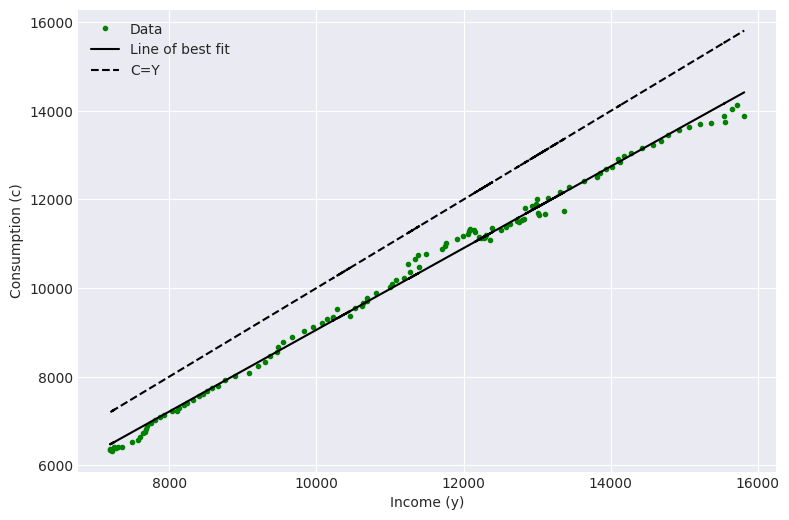
a_0 is -165.84
a_1 is 0.92
# However, our consumption data is [non-stationary](https://www.reed.edu/economics/parker/312/tschapters/S13_Ch_4.pdf) and this drives the previous
# estimate.
df.PCECC96.plot()
plt.xlabel("Date")
plt.ylabel("Consumption (c)")
save_figure("fred-real-consumption-over-time")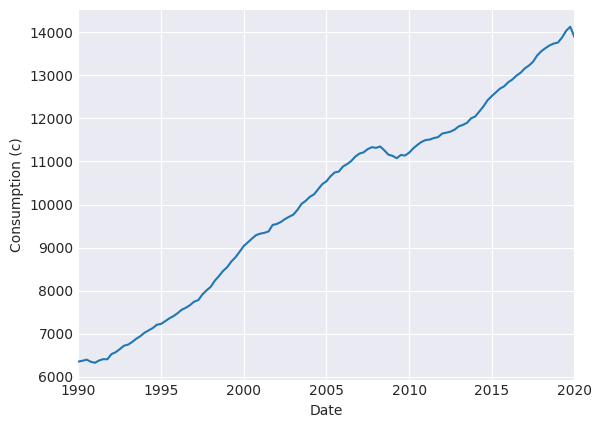
# Let's use our second equation to try to find an estimate of a_1

df_diff = df.diff()  # create dataframe of differenced values

# Plot the data
plt.figure(figsize=(9, 6))
plt.plot(df_diff.DPIC96, df_diff.PCECC96, "go", markersize=3.0, label="Data")
slope, intercept, r_value, p_value, std_err = stats.linregress(
    df_diff.DPIC96[1:], df_diff.PCECC96[1:]
)  # find line of best fit
plt.plot(
    df_diff.DPIC96[1:],
    intercept + slope * df_diff.DPIC96[1:],
    "k-",
    label="Line of best fit",
)
plt.plot(np.array([-200, 200]), np.array([-200, 200]), "k--", label="C=Y")
plt.xlabel("Change in income (dy)")
plt.ylabel("Change in consumption (dc)")
plt.legend()
save_figure("fred-quarterly-change-consumption-vs-income")
plt.show()

print("a_1 is {:.2f}".format(slope))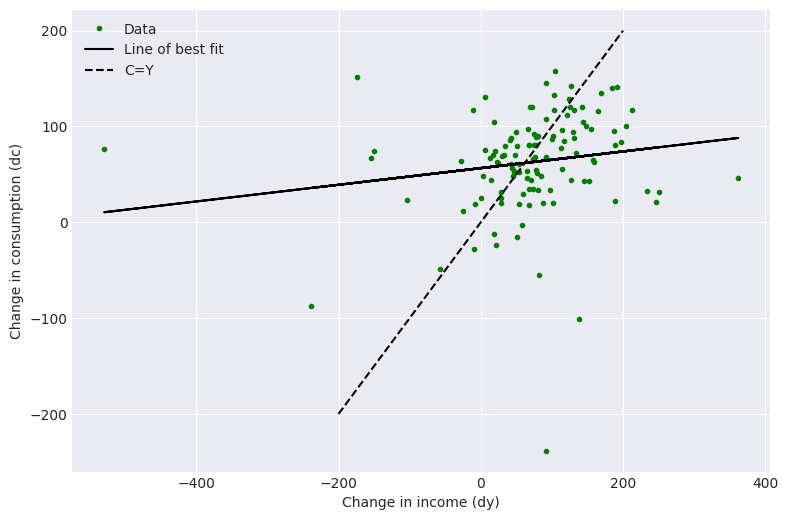
a_1 is 0.09
is now much lower than the estimate from levels.
This disagreement is the most important result in this section. If the Keynesian consumption function described how consumption is actually determined, its levels form and its first-difference form would be the same model, and estimating either way should give the same answer, up to sampling error. When two estimates that should be identical are this different, that is a powerful signal that the model is wrong in some profound way, or, in the more polite technical term, that it is misspecified. Refining the estimate of cannot fix this; the model itself has to change. Friedman’s permanent income hypothesis, below, is one such change, and it predicts exactly this pattern.
Household Data:
Cross-section plots of consumption and income: very large and significant , maybe 0.5.
Further facts:
Black households save more than whites at a given income level.
By income group:
low-income: Implausibly large dissaving (spend 2 or 3 times income)
high-income: Remarkably high saving
2. Duesenberry
Habit formation may explain why affects .
Relative Income Hypothesis suggests that you compare your consumption to consumption of ‘peers’.
May explain high saving rates of Black HHs.
Problems with Duesenberry:
No budget constraint
No serious treatment of intertemporal nature of saving
Duesenberry: Evidence
# Even if we control for income, past consumption seems to be significantly related to current consumption

df_habit = df.copy()
df_habit.columns = ["cons", "inc"]
df_habit["cons_m1"] = df.PCECC96.shift()
df_habit.dropna()

result = sm.ols(formula="cons ~ inc + cons_m1", data=df_habit.dropna()).fit()
result.summary()# The coefficient on lagged consumption is very significant.
# But regression may be statistically problematic for the usual [non-stationarity](https://towardsdatascience.com/stationarity-in-time-series-analysis-90c94f27322) reasons.3. Friedman’s Permanent Income Hypothesis
We can try to test this theory across households. If we run a regression of the form:
And if Friedman is correct, and the “true” coefficient on permanent income is 1, then the coefficient on will be:
Friedman’s Permanent Income Hypothesis
We begin by creating a class that implements the Friedman PIH consumption function as a special case of the Perfect Foresight CRRA model.
As discussed in the lecture notes, it is often convenient to represent this type of models in variables that are normalized by permanent income. That is the case for the HARK tools that we use below in the definition of our consumer. Therefore, the consumption function will expect
and compute
Therefore, to find consumption at a total level of income , we will use .
class FriedmanPIHConsumer:
    """
    This class represents consumers that behave according to
    Friedman's permanent income hypothesis, representing them as a
    special case of HARK's PerfForesightConsumerType

    Methods:
    - cFunc: computes consumption/permanent income
             given total income/permanent income.
    """

    def __init__(self, Rfree=1.001, CRRA=2):
        FriedmanPIH = (
            PerfForesightConsumerType()
        )  # set up a consumer type and use default parameters
        FriedmanPIH.cycles = 0  # Make this type have an infinite horizon
        FriedmanPIH.DiscFac = 1 / Rfree
        FriedmanPIH.Rfree = [Rfree]
        FriedmanPIH.LivPrb = [1.0]
        FriedmanPIH.PermGroFac = [1.0]
        FriedmanPIH.CRRA = CRRA
        FriedmanPIH.solve()  # solve the consumer's problem
        FriedmanPIH.unpack("cFunc")  # unpack the consumption function

        self.cFunc = FriedmanPIH.solution[0].cFunc
Now, think of a consumer that has a permanent income of 1. What will be his consumption at different levels of total observed income?
# We can now create a PIH consumer
PIHexample = FriedmanPIHConsumer()

# Plot the perfect foresight consumption function
income = np.linspace(0, 10, 20)  # pick some income points
plt.figure(figsize=(9, 6))
plt.plot(
    income, PIHexample.cFunc(income), label="Consumption function"
)  # plot income versus the consumption
plt.plot(income, income, "k--", label="C=Y")
plt.title("Consumption function")
plt.xlabel("Normalized Income (y)")
plt.ylabel("Normalized Consumption (c)")
plt.legend()
save_figure("pih-consumption-function")
plt.show()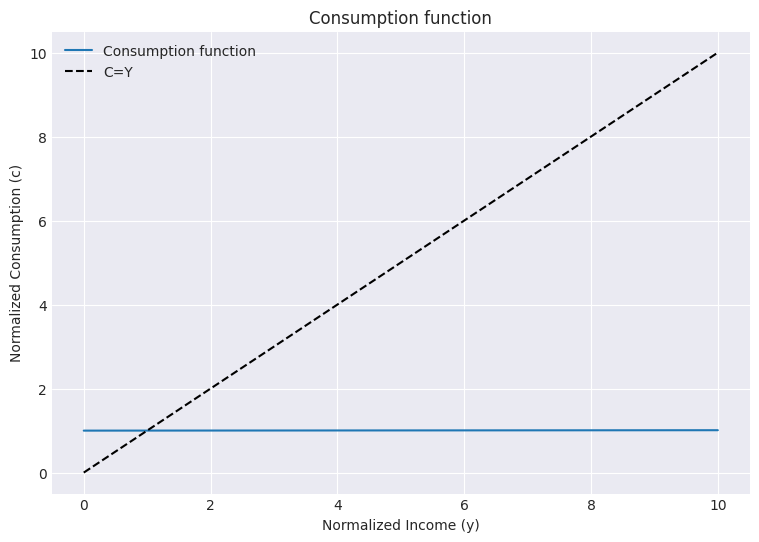
We can see that regardless of the income our agent receives, they consume their permanent income, which is normalized to 1.
We can also draw out some implications of the PIH that we can then test with evidence
If we look at HH’s who have very similar permanent incomes, we should get a small estimate of , because is large relative to .
Let’s simulate this using our consumer.
# Permanent income has the same variance
# as transitory income.

np.random.seed(0)

perm_inc = np.random.normal(1.0, 0.1, 200)
trans_inc = np.random.normal(0.5, 0.1, 200)

total_inc = perm_inc + trans_inc

slope, intercept, r_value, p_value, std_err = stats.linregress(
    total_inc, PIHexample.cFunc(total_inc / perm_inc) * perm_inc
)

plt.figure(figsize=(9, 6))
plt.plot(
    total_inc, PIHexample.cFunc(total_inc / perm_inc) * perm_inc, "go", label="Simulated data"
)
plt.plot(total_inc, intercept + slope * total_inc, "k-", label="Line of best fit")
plt.plot(np.linspace(1, 2, 5), np.linspace(1, 2, 5), "k--", label="C=Y")
plt.xlabel("Income (y)")
plt.ylabel("Consumption (c)")
plt.legend()
plt.ylim(0, 2)
plt.xlim(1.1, 1.9)
save_figure("pih-simulated-low-permanent-income-variance")
plt.show()

print("a_0 is {:.2f}".format(intercept))
print("a_1 is {:.2f}".format(slope))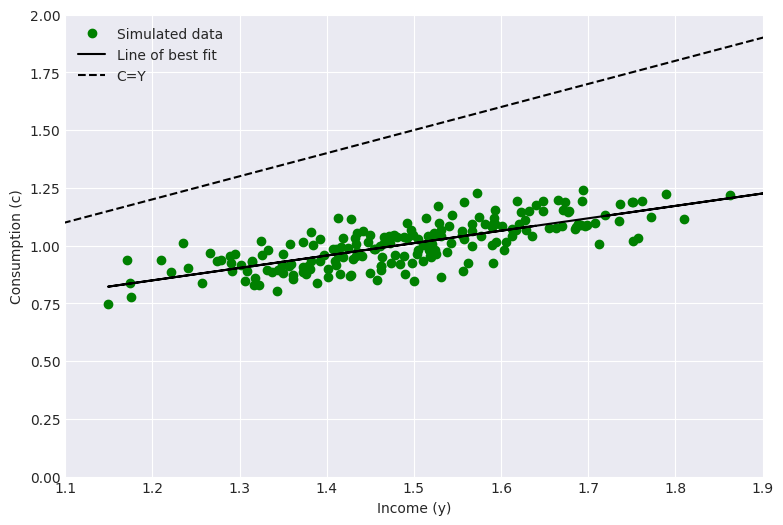
a_0 is 0.20
a_1 is 0.54
# Permanent income with higher variance

np.random.seed(0)

perm_inc = np.random.normal(1.0, 0.5, 200)
trans_inc = np.random.normal(0.5, 0.1, 200)

total_inc = perm_inc + trans_inc

slope, intercept, r_value, p_value, std_err = stats.linregress(
    total_inc, PIHexample.cFunc(total_inc / perm_inc) * perm_inc
)

plt.figure(figsize=(9, 6))
plt.plot(
    total_inc, PIHexample.cFunc(total_inc / perm_inc) * perm_inc, "go", label="Simulated data"
)
plt.plot(total_inc, intercept + slope * total_inc, "k-", label="Line of best fit")
plt.plot(np.linspace(0, 2, 5), np.linspace(0, 2, 5), "k--", label="C=Y")
plt.xlabel("Income (y)")
plt.ylabel("Consumption (c)")
plt.legend()
plt.ylim(0, 2)
save_figure("pih-simulated-high-permanent-income-variance")
plt.show()

print("a_0 is {:.2f}".format(intercept))
print("a_1 is {:.2f}".format(slope))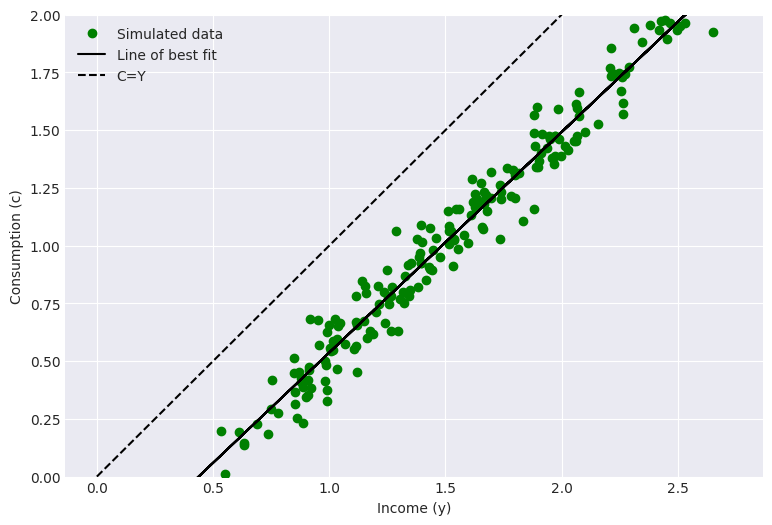
a_0 is -0.42
a_1 is 0.95
We can see that as we increase the variance of permanent income, the estimate of a_1 rises
Friedman’s Permanent Income Hypothesis: Evidence
We can now consider the empirical evidence for the claims our model made about the PIH.
If we take a long time series, then the differences in permanent income should be the main driver of the variance in total income. This implies that a_1 should be high.
If we take higher frequency time series (or cross sectional data), transitory shocks should dominate, and our estimate of a_1 should be lower.
Consider quarterly differences first:
# Let's use the data from FRED that we used before.

# Using quarterly data (copying from above), we had:

plt.figure(figsize=(9, 6))
plt.plot(df_diff.DPIC96, df_diff.PCECC96, "go", markersize=3.0, label="Data")
slope, intercept, r_value, p_value, std_err = stats.linregress(
    df_diff.DPIC96[1:], df_diff.PCECC96[1:]
)  # find line of best fit
plt.plot(
    df_diff.DPIC96[1:],
    intercept + slope * df_diff.DPIC96[1:],
    "k-",
    label="Line of best fit",
)
plt.plot(np.array([-200, 200]), np.array([-200, 200]), "k--", label="C=Y")
plt.xlabel("Change in income (dy)")
plt.ylabel("Change in consumption (dc)")
plt.legend()
plt.show()

print("a_1 is {:.2f}".format(slope))
a_1 is 0.09
And now consider longer time differences, 20 quarters for instance, where the changes in permanent income should dominate transitory effects
# Using longer differences
df_diff_long = df.diff(periods=20)  # create dataframe of differenced values
df_diff_long.columns = ["cons", "inc"]

plt.figure(figsize=(9, 6))
plt.plot(df_diff_long.inc, df_diff_long.cons, "go", label="Data")
slope, intercept, r_value, p_value, std_err = stats.linregress(
    df_diff_long.inc[20:], df_diff_long.cons[20:]
)  # find line of best fit
plt.plot(
    df_diff_long.inc[1:],
    intercept + slope * df_diff_long.inc[1:],
    "k-",
    label="Line of best fit",
)
plt.plot(np.linspace(-100, 2000, 3), np.linspace(-100, 2000, 3), "k--", label="C=Y")
plt.legend()
plt.xlabel("Change in income (dy)")
plt.ylabel("Change in consumption (dc)")
save_figure("fred-20-quarter-change-consumption-vs-income")
plt.show()

print("a_0 is {:.2f}".format(intercept))
print("a_1 is {:.2f}".format(slope))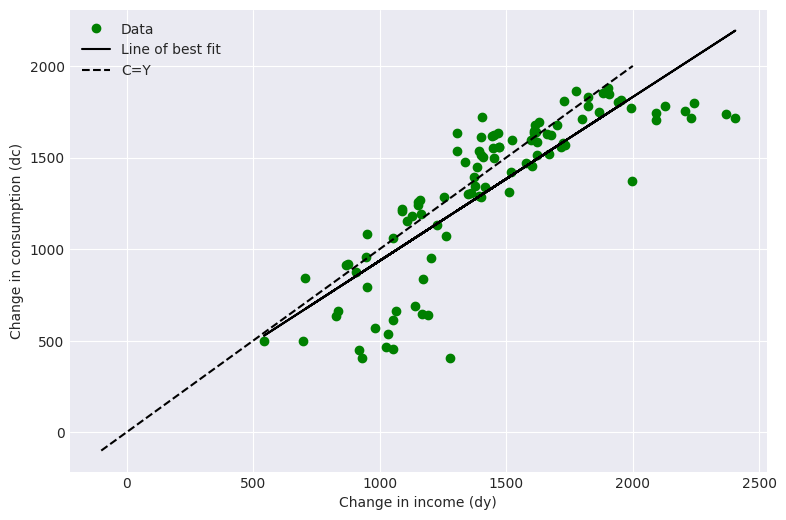
a_0 is 41.76
a_1 is 0.89
The estimate of using the longer differences is much higher because permanent income is playing a much more important role in explaining the variation in consumption.