 Powered by Econ-ARK
This module creates an example application extending PersistentShockConsumerType from ConsGenIndShockModel.
Most simply, it solves a consumption-saving model with shocks that are neither necessarily fully transitory nor fully permanent. Persistent income is tracked as a state variable and follows an AR(1) process.
What if beliefs about persistent income differ from actual ?
What if the consumer has beliefs about the persistence of his/her income process which differ from the actual persistence?
We can use the class PersistentShockConsumerType to solve the problem of a consumer with a given set of beliefs, but then simulate a population of consumers for whom that actual persistence differs from what they believe.
(This thought experiment is motivated by an interesting recent paper presented at the NBER Summer Institute’s Behavioral Macroeconomics Conference
# Initial imports and notebook setup, click arrow to show
import matplotlib.pyplot as plt

from copy import copy
import numpy as np

from HARK.ConsumptionSaving.ConsGenIncProcessModel import PersistentShockConsumerType
from HARK.distributions import Uniform
from HARK.utilities import get_lorenz_shares, calc_subpop_avg


def mystr(number):
    return "{:.4f}".format(number)
# This cell makes a subclass of PersistentShockConsumerType including the MPC
class PersistentShockConsumerTypeX(PersistentShockConsumerType):
def getControls(self):
cLvl = np.zeros(self.AgentCount) + np.nan
MPCnow = np.zeros(self.AgentCount) + np.nan
for t in range(self.T_cycle):
these = t == self.t_cycle
cLvl[these] = self.solution[t].cFunc(
self.state_now["mLvlNow"][these], self.state_now["pLvl"][these]
)
MPCnow[these] = self.solution[t].cFunc.derivativeX(
self.state_now["mLvlNow"][these], self.state_now["pLvl"][these]
)
self.controls["cLvl"] = cLvl
self.MPCnow = MPCnow# This cell defines a dictionary to make an instance of "persistent shocks" consumer for the infinite horizon model
BaselineDict = {
"CRRA": 2.0, # Coefficient of relative risk aversion
"Rfree": [1.01 / (1.0 - 1.0 / 160.0)], # Interest factor on assets
"DiscFac": 0.97, # Default intertemporal discount factor
"LivPrb": [1.0 - 1.0 / 160.0], # Survival probability
# Number of agents of this type (only matters for simulation)
"AgentCount": 10000,
"IndL": 10.0 / 9.0, # Labor supply per individual (constant)
"kLogInitMean": np.log(
0.00001
), # Mean of log initial assets (only matters for simulation)
# Standard deviation of log initial assets (only for simulation)
"kLogInitStd": 0.0,
# Mean of log initial permanent income (only matters for simulation)
"pLogInitMean": 0.0,
# Standard deviation of log initial permanent income (only matters for simulation)
"pLogInitStd": 0.0,
# Aggregate permanent income growth factor (only matters for simulation)
"PermGroFacAgg": 1.0,
"T_age": 400, # Age after which simulated agents are automatically killed
"T_cycle": 1, # Number of periods in the cycle for this agent type
# Number of periods to simulate (idiosyncratic shocks model, perpetual youth)
"T_sim": 1200,
"aXtraMin": 0.001, # Minimum end-of-period "assets above minimum" value
"aXtraMax": 30, # Maximum end-of-period "assets above minimum" value
"aXtraExtra": [
0.005,
0.01,
], # Some other value of "assets above minimum" to add to the grid
# Exponential nesting factor when constructing "assets above minimum" grid
"aXtraNestFac": 3,
"aXtraCount": 48, # Number of points in the grid of "assets above minimum"
"PermShkCount": 7, # Number of points in discrete approximation to permanent income shocks
"TranShkCount": 7, # Number of points in discrete approximation to transitory income shocks
"PermShkStd": [
(0.01 * 4 / 11) ** 0.5
], # Standard deviation of permanent shocks to income
"TranShkStd": [
(0.01 * 4) ** 0.5
], # Standard deviation of transitory shocks to income
"UnempPrb": 0.05, # Probability of unemployment while working
"UnempPrbRet": 0.005, # Probability of "unemployment" while retired
"IncUnemp": 0.3, # Unemployment benefits replacement rate
"IncUnempRet": 0.0, # "Unemployment" benefits when retired
"tax_rate": 0.0, # Flat income tax rate
"T_retire": 0, # Period of retirement (0 --> no retirement)
# Artificial borrowing constraint; imposed minimum level of end-of period assets
"BoroCnstArt": 0.0,
# Use cubic spline interpolation when True, linear interpolation when False
"CubicBool": False,
"vFuncBool": True, # Whether to calculate the value function during solution
"cycles": 0, # Make this type have an infinite horizon
"pLvlPctiles": np.concatenate(
(
[0.001, 0.005, 0.01, 0.03],
np.linspace(0.05, 0.95, num=19),
[0.97, 0.99, 0.995, 0.999],
)
),
# Permanent income growth factor (no perm growth)
"PermGroFac": [1.000**0.25],
"PrstIncCorr": 0.99, # Serial correlation coefficient for persistence of income
}# This cell defines a function to solve and simulate a consumer misperceiving the correlation of persistent income shocks
def runRoszypalSchlaffmanExperiment(CorrAct, CorrPcvd, DiscFac_center, DiscFac_spread):
"""
Solve and simulate a consumer type who misperceives the extent of serial correlation
of persistent shocks to income.
Parameters
----------
CorrAct : float
Serial correlation coefficient for *actual* persistent income.
CorrPcvd : float
List or array of *perceived* persistent income.
DiscFac_center : float
A measure of centrality for the distribution of the beta parameter, DiscFac.
DiscFac_spread : float
A measure of spread or diffusion for the distribution of the beta parameter.
Returns
-------
AggWealthRatio: float
Ratio of Aggregate wealth to income.
Lorenz: numpy.array
A list of two 1D array reprensenting the Lorenz curve for assets in the most recent simulated period.
Gini: float
Gini coefficient for assets in the most recent simulated period.
Avg_MPC: numpy.array
Average marginal propensity to consume by income quintile in the latest simulated period.
"""
# Make a dictionary to construct our consumer type
ThisDict = copy(BaselineDict)
ThisDict["PrstIncCorr"] = CorrAct
# Make a 7 point approximation to a uniform distribution of DiscFac
DiscFac_list = (
Uniform(
bot=DiscFac_center - DiscFac_spread, top=DiscFac_center + DiscFac_spread
)
.discretize(N=7)
.atoms.flatten()
)
type_list = []
# Make a PersistentShockConsumerTypeX for each value of beta saved in DiscFac_list
for beta in DiscFac_list:
ThisDict["DiscFac"] = beta
ThisType = PersistentShockConsumerTypeX(**ThisDict)
# Make the consumer type *believe* he will face a different level of persistence
ThisType.PrstIncCorr = CorrPcvd
# Now he *thinks* E[p_{t+1}] as a function of p_t is different than it is
ThisType.update("pLvlNextFunc")
# Solve the consumer's problem with *perceived* persistence
ThisType.solve()
# Make the consumer type experience the true level of persistence during simulation
ThisType.PrstIncCorr = CorrAct
ThisType.update("pLvlNextFunc")
# Simulate the agents for many periods
# ThisType.track_vars = ['cLvl','aLvl','pLvl','MPCnow']
ThisType.initialize_sim()
ThisType.simulate()
type_list.append(ThisType)
# Get the most recent simulated values of X = cLvl, MPCnow, aLvl, pLvl for all types
np.concatenate([ThisType.controls["cLvl"] for ThisType in type_list])
aLvl_all = np.concatenate([ThisType.state_now["aLvl"] for ThisType in type_list])
MPC_all = np.concatenate([ThisType.MPCnow for ThisType in type_list])
pLvl_all = np.concatenate([ThisType.state_now["pLvl"] for ThisType in type_list])
# The ratio of aggregate assets over the income
AggWealthRatio = np.mean(aLvl_all) / np.mean(pLvl_all)
# first 1D array: Create points in the range (0,1)
wealth_percentile = np.linspace(0.001, 0.999, 201)
# second 1D array: Compute Lorenz shares for the created points
Lorenz_init = get_lorenz_shares(aLvl_all, percentiles=wealth_percentile)
# Stick 0 and 1 at the boundaries of both arrays to make it inclusive on the range [0,1]
Lorenz_init = np.concatenate([[0], Lorenz_init, [1]])
wealth_percentile = np.concatenate([[0], wealth_percentile, [1]])
# Create a list of wealth_percentile 1D array and Lorenz Shares 1D array
Lorenz = np.stack((wealth_percentile, Lorenz_init))
# Compute the Gini coefficient
Gini = 1.0 - 2.0 * np.mean(Lorenz_init)
# Compute the average MPC by income quintile in the latest simulated period
Avg_MPC = calc_subpop_avg(
MPC_all,
pLvl_all,
cutoffs=[(0.0, 0.2), (0.2, 0.4), (0.4, 0.6), (0.6, 0.8), (0.8, 1.0)],
)
return AggWealthRatio, Lorenz, Gini, Avg_MPCThe user needs to call the function runRoszypalSchlaffmanExperiment with specific values for CorrAct, CorrPcvd and estimates of DiscFac_center and DiscFac_spread to solve the model accordingly.
# Call the function with test values for (CorrAct, CorrPcvd, DiscFac_center, DiscFac_spread)
AggWealthRatio, Lorenz, Gini, Avg_MPC = runRoszypalSchlaffmanExperiment(
    0.97, 0.9831, 0.9867, 0.0067
)

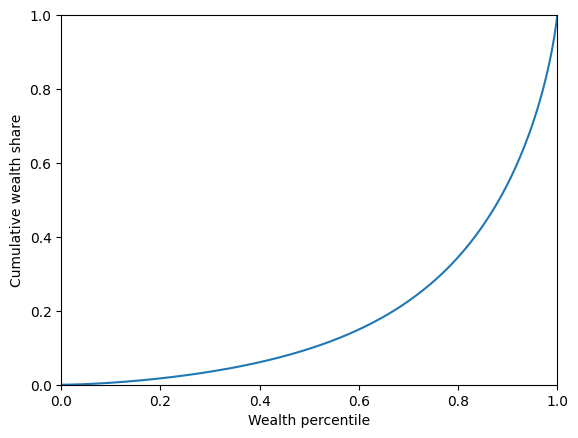
# Plot the Lorenz curve
print("The Lorenz curve for assets is")
plt.plot(Lorenz[0], Lorenz[1])
plt.xlabel("Wealth percentile")
plt.ylabel("Cumulative wealth share")
plt.xlim([0.0, 1.0])
plt.ylim([0.0, 1.0])
plt.show()

print("The aggregate wealth to income ratio is " + str(AggWealthRatio))
print("The Gini Coefficient for assests is " + str(Gini))
print("The average MPC by income quintile is " + str(np.round(Avg_MPC, 4)))
The Lorenz curve for assets is
The aggregate wealth to income ratio is 8.15825229070561
The Gini Coefficient for assests is 0.6099542324913643
The average MPC by income quintile is [0.0594 0.0519 0.0522 0.0458 0.0274]