 Powered by Econ-ARK
A notebook by Christopher D. Carroll and Mateo Velásquez-Giraldo
Inspired by its Quantecon counterpart
This notebook presents simple computational tools to solve an instance of Lucas’s asset-pricing model for which there is no analytical solution: The case when the logarithm of the asset’s dividend follows an autoregressive process of order 1,
A presentation of this model can be found in Christopher D. Carroll’s lecture notes.
Those notes use the Bellman equation to derive a relationship between the price of the asset in the current period and the next period :
The equilibrium pricing equation is a relationship between the price and the dividend (a “pricing kernel”) such that, if everyone believes that to be the pricing kernel, everyone’s Euler equation will be satisfied:
As noted in the handout, there are some special circumstances in which it is possible to solve for analytically:
| Shock Process | Mean Restrictions | CRRA | Solution for Pricing Kernel |
|---|---|---|---|
| bounded, IID, | 1 (log) | ||
| lognormal, mean 1 | |||
| lognormal mean |
However, under most circumstances, the only way to obtain the pricing function is by solving for it numerically, as outlined below.
Finding the equilibrium pricing function.
We know that the equilibrium pricing function must satisfy the equation above. Let’s define an operator that allows us to evaluate whether any candidate pricing function satisfies this requirement.
Let be an operator which takes as argument a function and returns another function (these are usually called functionals or higher-order functions). For some function , denote with the function that results from applying to . Then, for any real number , will be the real number that one obtains when the function is given as an input.
We define our particular operator as follows. For any function , is obtained as
We can use to re-express our pricing equation. If is our equilibrium pricing funtion, it must satisfy
or, expressed differently,
Our equilibrium pricing function is therefore a fixed point of the operator .
It turns out that is a contraction mapping. This is useful because it implies, through Banach’s fixed-point theorem, that:
has exactly one fixed point.
Starting from an arbitrary function , the sequence converges to that fixed point.
For our purposes, this translates to:
Our equilibrium pricing function not only exists, but is unique.
We can get arbitrarily close to the equilibrium pricing function by making some initial guess and applying the operator to it repeatedly.
The code below creates a representation of our model and implements a solution routine to find . The main components of this routine are:
priceOnePeriod: this is operator from above. It takes a function , computes for a grid of values, and uses the result to construct a piecewise linear interpolator that approximates .solve: this is our iterative solution procedure. It generates an initial guess and appliespriceOnePeriodto it iteratively. At each application, it constructs a measure of how much the candidate pricing function changed. Once changes between successive iterations are small enough, it declares that the solution has converged.
A computational representation of the problem and its solution.
Uninteresting setup:
# Setup
import numpy as np
import matplotlib.pyplot as plt
from copy import copy

from HARK.rewards import CRRAutilityP
from HARK.distributions import Normal, expected
from HARK.interpolation import LinearInterp, ConstantFunction
# A python class representing log-AR1 dividend processes.
class DivProcess:
def __init__(self, α, σ, γ=0.0, nApprox=7):
self.α = α
self.σ = σ
self.γ = γ
self.nApprox = nApprox
# Create a discrete approximation to the random shock
self.ShkAppDstn = Normal(mu=-(σ**2) / 2, sigma=σ).discretize(N=nApprox)
def getLogdGrid(self, n=100):
"""
A method for creating a reasonable grid for log-dividends.
"""
μ = self.γ - (self.σ**2) / 2
uncond_sd = self.σ / np.sqrt(1 - self.α**2)
uncond_mean = μ / (1 - self.α)
logDGrid = np.linspace(-5 * uncond_sd, 5 * uncond_sd, n) + uncond_mean
return logDGrid
# A class representing economies with Lucas trees.
class LucasEconomy:
"""
A representation of an economy in which there are Lucas trees
whose dividends' logarithm follows an AR1 process.
"""
def __init__(self, CRRA, DiscFac, DivProcess):
self.CRRA = CRRA
self.DiscFac = DiscFac
self.DivProcess = DivProcess
self.uP = lambda c: CRRAutilityP(c, self.CRRA)
def priceOnePeriod(self, Pfunc_next, logDGrid):
# Create a function that, given current dividends
# and the value of next period's shock, returns
# the discounted value derived from the asset next period.
def discounted_value(shock, log_d_now):
# Find dividends
d_now = np.exp(log_d_now)
log_d_next = self.DivProcess.γ + self.DivProcess.α * log_d_now + shock
d_next = np.exp(log_d_next)
# Payoff and sdf
payoff_next = Pfunc_next(log_d_next) + d_next
SDF = self.DiscFac * self.uP(d_next / d_now)
return SDF * payoff_next
# The price at a given d_t is the expectation of the discounted value.
# Compute it at every d in our grid. The expectation is taken over next
# period's shocks
prices_now = expected(
dstn=self.DivProcess.ShkAppDstn, func=discounted_value, args=(logDGrid,)
)
# Create new interpolating price function
Pfunc_now = LinearInterp(logDGrid, prices_now, lower_extrap=True)
return Pfunc_now
def solve(self, Pfunc_0=None, logDGrid=None, tol=1e-5, maxIter=500, disp=False):
# Initialize the norm
norm = tol + 1
# Initialize Pfunc if initial guess is not provided
if Pfunc_0 is None:
Pfunc_0 = ConstantFunction(0.0)
# Create a grid for log-dividends if one is not provided
if logDGrid is None:
logDGrid = self.DivProcess.getLogdGrid()
# Initialize function and compute prices on the grid
Pf_0 = copy(Pfunc_0)
P_0 = Pf_0(logDGrid)
it = 0
while norm > tol and it < maxIter:
# Apply the pricing equation
Pf_next = self.priceOnePeriod(Pf_0, logDGrid)
# Find new prices on the grid
P_next = Pf_next(logDGrid)
# Measure the change between price vectors
norm = np.linalg.norm(P_0 - P_next)
# Update price function and vector
Pf_0 = Pf_next
P_0 = P_next
it = it + 1
# Print iteration information
if disp:
print("Iter:" + str(it) + " Norm = " + str(norm))
if disp:
if norm <= tol:
print("Price function converged!")
else:
print("Maximum iterations exceeded!")
self.EqlogPfun = Pf_0
self.EqPfun = lambda d: self.EqlogPfun(np.log(d))Creating and solving an example economy with AR1 dividends
An economy is fully specified by:
The dividend process for the assets (trees): we assume that , . We must create a dividend process specifying and .
The coefficient of relative risk aversion (CRRA).
The time-discount factor ().
# Create a log-AR1 process for dividends
DivProc = DivProcess(α=0.90, σ=0.1)

# Create an example economy
economy = LucasEconomy(CRRA=2, DiscFac=0.95, DivProcess=DivProc)
Once created, the economy can be ‘solved’, which means finding the equilibrium price kernel. The distribution of dividends at period depends on the value of dividends at , which also determines the resources agents have available to buy trees. Thus, is a state variable for the economy. The pricing function gives the price of trees that equates their demand and supply at every level of current dividends .
# Solve the economy, displaying the error term for each iteration
economy.solve(disp=True)

# After the economy is solved, we can use its Equilibrium price function
# to tell us the price if the dividend is 1
dvdnd = 1
print("P({}) = {:.6}".format(dvdnd, economy.EqPfun(dvdnd)))
Iter:1 Norm = 14.34310594086344
Iter:2 Norm = 14.614867281705973
Iter:3 Norm = 14.81462233119635
Iter:4 Norm = 14.939364249843898
Iter:5 Norm = 14.989619417063073
Iter:6 Norm = 14.968432855040843
Iter:7 Norm = 14.880572667620452
Iter:8 Norm = 14.731927474014178
Iter:9 Norm = 14.52902047558161
Iter:10 Norm = 14.278638854628227
Iter:11 Norm = 13.987555448796973
Iter:12 Norm = 13.662325970904508
Iter:13 Norm = 13.309147997993502
Iter:14 Norm = 12.933769279362002
Iter:15 Norm = 12.54143477811982
Iter:16 Norm = 12.136863389363548
Iter:17 Norm = 11.724246791512238
Iter:18 Norm = 11.307264248656217
Iter:19 Norm = 10.88910839449017
Iter:20 Norm = 10.472518082357068
Iter:21 Norm = 10.059815280329328
Iter:22 Norm = 9.652943734511805
Iter:23 Norm = 9.253507730992833
Iter:24 Norm = 8.862809773368175
Iter:25 Norm = 8.481886375493007
Iter:26 Norm = 8.111541464653394
Iter:27 Norm = 7.752377114027517
Iter:28 Norm = 7.40482148881162
Iter:29 Norm = 7.069154009563337
Iter:30 Norm = 6.745527819188153
Iter:31 Norm = 6.43398969488094
Iter:32 Norm = 6.134497580005358
Iter:33 Norm = 5.846935928796937
Iter:34 Norm = 5.571129063207857
Iter:35 Norm = 5.306852739535748
Iter:36 Norm = 5.053844115275684
Iter:37 Norm = 4.8118102958592255
Iter:38 Norm = 4.5804356280614105
Iter:39 Norm = 4.359387892926313
Iter:40 Norm = 4.148323536855
Iter:41 Norm = 3.946892065541599
Iter:42 Norm = 3.7547397120884534
Iter:43 Norm = 3.5715124781038123
Iter:44 Norm = 3.3968586350059407
Iter:45 Norm = 3.23043076218392
Iter:46 Norm = 3.071887389099951
Iter:47 Norm = 2.92089429983745
Iter:48 Norm = 2.777125550947055
Iter:49 Norm = 2.6402642466621504
Iter:50 Norm = 2.5100031095739235
Iter:51 Norm = 2.386044879600522
Iter:52 Norm = 2.2681025694850425
Iter:53 Norm = 2.155899601045683
Iter:54 Norm = 2.049169842908783
Iter:55 Norm = 1.9476575674272367
Iter:56 Norm = 1.8511173418645133
Iter:57 Norm = 1.7593138666580201
Iter:58 Norm = 1.672021771624408
Iter:59 Norm = 1.5890253792862712
Iter:60 Norm = 1.510118443058598
Iter:61 Norm = 1.4351038667929092
Iter:62 Norm = 1.3637934111186265
Iter:63 Norm = 1.2960073911146144
Iter:64 Norm = 1.2315743690705385
Iter:65 Norm = 1.1703308454400114
Iter:66 Norm = 1.1121209505264746
Iter:67 Norm = 1.0567961389685152
Iter:68 Norm = 1.004214888688016
Iter:69 Norm = 0.9542424056244561
Iter:70 Norm = 0.9067503352925078
Iter:71 Norm = 0.8616164819572083
Iter:72 Norm = 0.818724536020655
Iter:73 Norm = 0.777963810043275
Iter:74 Norm = 0.7392289836834438
Iter:75 Norm = 0.7024198577214298
Iter:76 Norm = 0.6674411172382658
Iter:77 Norm = 0.634202103941166
Iter:78 Norm = 0.6026165975626904
Iter:79 Norm = 0.5726026062095858
Iter:80 Norm = 0.5440821654963686
Iter:81 Norm = 0.5169811462657242
Iter:82 Norm = 0.49122907067358845
Iter:83 Norm = 0.4667589363979194
Iter:84 Norm = 0.44350704871700236
Iter:85 Norm = 0.421412860193699
Iter:86 Norm = 0.4004188176968008
Iter:87 Norm = 0.3804702164882355
Iter:88 Norm = 0.3615150611045491
Iter:89 Norm = 0.3435039327628806
Iter:90 Norm = 0.32638986302583317
Iter:91 Norm = 0.31012821346309866
Iter:92 Norm = 0.2946765610546749
Iter:93 Norm = 0.27999458908628433
Iter:94 Norm = 0.2660439832949772
Iter:95 Norm = 0.2527883330301617
Iter:96 Norm = 0.24019303720337631
Iter:97 Norm = 0.2282252148079118
Iter:98 Norm = 0.21685361979727616
Iter:99 Norm = 0.20604856012013625
Iter:100 Norm = 0.19578182071641212
Iter:101 Norm = 0.18602659028839066
Iter:102 Norm = 0.1767573916672117
Iter:103 Norm = 0.16795001560349337
Iter:104 Norm = 0.15958145781814148
Iter:105 Norm = 0.1516298591567478
Iter:106 Norm = 0.14407444869702674
Iter:107 Norm = 0.13689548966714943
Iter:108 Norm = 0.1300742280379809
Iter:109 Norm = 0.1235928436590115
Iter:110 Norm = 0.1174344038138782
Iter:111 Norm = 0.11158281907722094
Iter:112 Norm = 0.10602280136006649
Iter:113 Norm = 0.10073982403589372
Iter:114 Norm = 0.09572008404579596
Iter:115 Norm = 0.09095046588484632
Iter:116 Norm = 0.08641850737699282
Iter:117 Norm = 0.08211236714998044
Iter:118 Norm = 0.07802079372731051
Iter:119 Norm = 0.07413309615584784
Iter:120 Norm = 0.07043911609430371
Iter:121 Norm = 0.06692920128960075
Iter:122 Norm = 0.06359418037268635
Iter:123 Norm = 0.06042533890809264
Iter:124 Norm = 0.057414396635407663
Iter:125 Norm = 0.054553485843217786
Iter:126 Norm = 0.05183513081936258
Iter:127 Norm = 0.049252228324352595
Iter:128 Norm = 0.04679802903643489
Iter:129 Norm = 0.04446611992096433
Iter:130 Norm = 0.04225040747722925
Iter:131 Norm = 0.040145101819746856
Iter:132 Norm = 0.03814470155217281
Iter:133 Norm = 0.03624397939444744
Iter:134 Norm = 0.03443796852609161
Iter:135 Norm = 0.03272194960916258
Iter:136 Norm = 0.031091438458342148
Iter:137 Norm = 0.029542174324315832
Iter:138 Norm = 0.028070108761445414
Iter:139 Norm = 0.02667139504984569
Iter:140 Norm = 0.025342378144178373
Iter:141 Norm = 0.024079585123435457
Iter:142 Norm = 0.022879716116425367
Iter:143 Norm = 0.021739635679333864
Iter:144 Norm = 0.020656364602714354
Iter:145 Norm = 0.019627072127070527
Iter:146 Norm = 0.018649068545766374
Iter:147 Norm = 0.01771979817680735
Iter:148 Norm = 0.016836832684830137
Iter:149 Norm = 0.015997864735649348
Iter:150 Norm = 0.015200701966844189
Iter:151 Norm = 0.014443261259211396
Iter:152 Norm = 0.013723563293191268
Iter:153 Norm = 0.013039727376824886
Iter:154 Norm = 0.012389966531120225
Iter:155 Norm = 0.011772582820757146
Iter:156 Norm = 0.011185962916935679
Iter:157 Norm = 0.01062857388152953
Iter:158 Norm = 0.010098959161571077
Iter:159 Norm = 0.009595734782801998
Iter:160 Norm = 0.00911758573331583
Iter:161 Norm = 0.008663262527145959
Iter:162 Norm = 0.008231577939258631
Iter:163 Norm = 0.007821403903143986
Iter:164 Norm = 0.007431668562953552
Iter:165 Norm = 0.007061353472598732
Iter:166 Norm = 0.006709490934464021
Iter:167 Norm = 0.0063751614704972495
Iter:168 Norm = 0.006057491419614152
Iter:169 Norm = 0.005755650654652022
Iter:170 Norm = 0.005468850413064407
Iter:171 Norm = 0.005196341235730253
Iter:172 Norm = 0.004937411008699256
Iter:173 Norm = 0.004691383101932497
Iter:174 Norm = 0.004457614601632301
Iter:175 Norm = 0.004235494629770892
Iter:176 Norm = 0.004024442748025629
Iter:177 Norm = 0.003823907440919708
Iter:178 Norm = 0.0036333646745771654
Iter:179 Norm = 0.003452316527362579
Iter:180 Norm = 0.0032802898888329274
Iter:181 Norm = 0.0031168352231918865
Iter:182 Norm = 0.002961525394785437
Iter:183 Norm = 0.0028139545518366246
Iter:184 Norm = 0.00267373706579672
Iter:185 Norm = 0.0025405065238508634
Iter:186 Norm = 0.0024139147712710584
Iter:187 Norm = 0.0022936310014923895
Iter:188 Norm = 0.0021793408920568543
Iter:189 Norm = 0.0020707457828244703
Iter:190 Norm = 0.0019675618956923836
Iter:191 Norm = 0.0018695195930966792
Iter:192 Norm = 0.0017763626732945814
Iter:193 Norm = 0.0016878477009181062
Iter:194 Norm = 0.001603743370814542
Iter:195 Norm = 0.001523829903624448
Iter:196 Norm = 0.0014478984714075974
Iter:197 Norm = 0.001375750651995658
Iter:198 Norm = 0.0013071979105175545
Iter:199 Norm = 0.001242061106635624
Iter:200 Norm = 0.0011801700264542725
Iter:201 Norm = 0.0011213629376277934
Iter:202 Norm = 0.0010654861670085145
Iter:203 Norm = 0.0010123936987695278
Iter:204 Norm = 0.0009619467929445259
Iter:205 Norm = 0.0009140136229716336
Iter:206 Norm = 0.0008684689310220655
Iter:207 Norm = 0.0008251937008250442
Iter:208 Norm = 0.0007840748465884144
Iter:209 Norm = 0.0007450049175648438
Iter:210 Norm = 0.0007078818171773037
Iter:211 Norm = 0.0006726085362432564
Iter:212 Norm = 0.0006390928994664652
Iter:213 Norm = 0.0006072473245952711
Iter:214 Norm = 0.0005769885936040177
Iter:215 Norm = 0.0005482376350572404
Iter:216 Norm = 0.0005209193177180375
Iter:217 Norm = 0.0004949622539685552
Iter:218 Norm = 0.00047029861347630916
Iter:219 Norm = 0.0004468639458267492
Iter:220 Norm = 0.0004245970121032102
Iter:221 Norm = 0.00040343962488112255
Iter:222 Norm = 0.00038333649621035825
Iter:223 Norm = 0.00036423509313689677
Iter:224 Norm = 0.00034608550026885444
Iter:225 Norm = 0.00032884028958809217
Iter:226 Norm = 0.0003124543962759582
Iter:227 Norm = 0.0002968850011565627
Iter:228 Norm = 0.00028209141866892884
Iter:229 Norm = 0.0002680349905576475
Iter:230 Norm = 0.0002546789849357291
Iter:231 Norm = 0.00024198850023253644
Iter:232 Norm = 0.0002299303738882025
Iter:233 Norm = 0.00021847309604241106
Iter:234 Norm = 0.00020758672670371484
Iter:235 Norm = 0.000197242817963524
Iter:236 Norm = 0.00018741433928826714
Iter:237 Norm = 0.00017807560717920262
Iter:238 Norm = 0.00016920221791301237
Iter:239 Norm = 0.00016077098373458665
Iter:240 Norm = 0.00015275987235465702
Iter:241 Norm = 0.00014514794933610434
Iter:242 Norm = 0.000137915323380576
Iter:243 Norm = 0.00013104309440237102
Iter:244 Norm = 0.00012451330400711154
Iter:245 Norm = 0.00011830888873856297
Iter:246 Norm = 0.00011241363536902475
Iter:247 Norm = 0.0001068121385326778
Iter:248 Norm = 0.00010148976060521523
Iter:249 Norm = 9.643259320029383e-05
Iter:250 Norm = 9.162742108566186e-05
Iter:251 Norm = 8.706168754619847e-05
Iter:252 Norm = 8.272346145365097e-05
Iter:253 Norm = 7.860140630130716e-05
Iter:254 Norm = 7.468475039819174e-05
Iter:255 Norm = 7.096325889746349e-05
Iter:256 Norm = 6.742720682601107e-05
Iter:257 Norm = 6.406735387874806e-05
Iter:258 Norm = 6.087492015769238e-05
Iter:259 Norm = 5.784156329083827e-05
Iter:260 Norm = 5.495935660985967e-05
Iter:261 Norm = 5.222076833999482e-05
Iter:262 Norm = 4.9618642107046365e-05
Iter:263 Norm = 4.7146178127042934e-05
Iter:264 Norm = 4.4796915380576354e-05
Iter:265 Norm = 4.256471482312034e-05
Iter:266 Norm = 4.044374335343422e-05
Iter:267 Norm = 3.8428458452395206e-05
Iter:268 Norm = 3.65135939085278e-05
Iter:269 Norm = 3.469414577592586e-05
Iter:270 Norm = 3.296535953101107e-05
Iter:271 Norm = 3.132271751942793e-05
Iter:272 Norm = 2.9761927333477716e-05
Iter:273 Norm = 2.827891023551752e-05
Iter:274 Norm = 2.686979091958857e-05
Iter:275 Norm = 2.5530887075460387e-05
Iter:276 Norm = 2.4258699903291916e-05
Iter:277 Norm = 2.304990500900857e-05
Iter:278 Norm = 2.1901343559741297e-05
Iter:279 Norm = 2.0810014136204545e-05
Iter:280 Norm = 1.9773064945727455e-05
Iter:281 Norm = 1.8787786251643173e-05
Iter:282 Norm = 1.7851603329965908e-05
Iter:283 Norm = 1.696206980654742e-05
Iter:284 Norm = 1.611686111768278e-05
Iter:285 Norm = 1.5313768645419402e-05
Iter:286 Norm = 1.4550693695290708e-05
Iter:287 Norm = 1.3825642320721789e-05
Iter:288 Norm = 1.313671972337381e-05
Iter:289 Norm = 1.2482125690853726e-05
Iter:290 Norm = 1.1860149638043228e-05
Iter:291 Norm = 1.126916627003413e-05
Iter:292 Norm = 1.0707631213278965e-05
Iter:293 Norm = 1.0174077062486109e-05
Iter:294 Norm = 9.667109531709195e-06
Price function converged!
P(1) = 20.1571
The effect of risk aversion.
The notes discuss the surprising implication that an increase in the coefficient of relative risk aversion leads to higher prices for the risky trees! This is demonstrated below.
# Create two economies with different risk aversion
Disc = 0.95
LowCRRAEcon = LucasEconomy(CRRA=2, DiscFac=Disc, DivProcess=DivProc)
HighCRRAEcon = LucasEconomy(CRRA=4, DiscFac=Disc, DivProcess=DivProc)

# Solve both
LowCRRAEcon.solve()
HighCRRAEcon.solve()

# Plot the pricing functions for both
dGrid = np.linspace(0.5, 2.5, 30)
plt.figure()
plt.plot(dGrid, LowCRRAEcon.EqPfun(dGrid), label="Low CRRA")
plt.plot(dGrid, HighCRRAEcon.EqPfun(dGrid), label="High CRRA")
plt.legend()
plt.xlabel("$d_t$")
plt.ylabel("$P_t$")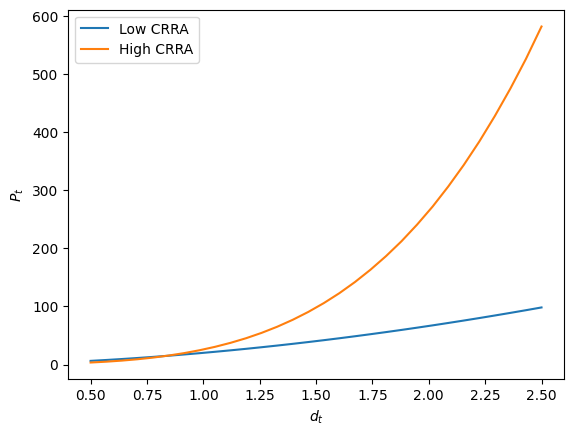
Testing our analytical solutions
Case 1: Log Utility
The lecture notes show that with logarithmic utility (a CRRA of 1), the pricing kernel has a closed form expression:
.
We now compare our numerical solution with this analytical expression.
# Create an economy with log utility and the same dividend process from before
logUtilEcon = LucasEconomy(CRRA=1, DiscFac=Disc, DivProcess=DivProc)
# Solve it
logUtilEcon.solve()

# Generate a function with our analytical solution
theta = 1 / Disc - 1


def aSol(d):
    return d / theta


# Get a grid for d over which to compare them
dGrid = np.exp(DivProc.getLogdGrid())

# Plot both
plt.figure()
plt.plot(dGrid, aSol(dGrid), "*", label="Analytical solution")
plt.plot(dGrid, logUtilEcon.EqPfun(dGrid), label="Numerical solution")
plt.legend()
plt.xlabel("$d_t$")
plt.ylabel("$P^*(d_t)$")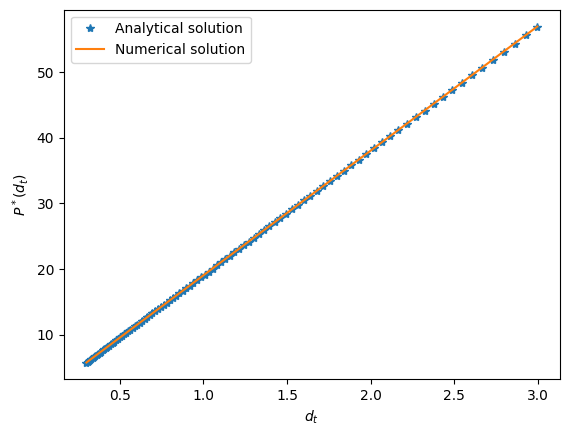
Case 2: I.I.D dividends
The notes also show that, if for all , the pricing kernel is exactly
We now our numerical solution for this case.
# Create an i.i.d. dividend process
σ = 0.1
iidDivs = DivProcess(α=0.0, σ=σ)

# And an economy that embeds it
CRRA = 2
Disc = 0.9

iidEcon = LucasEconomy(CRRA=CRRA, DiscFac=Disc, DivProcess=iidDivs)
iidEcon.solve()

# Generate a function with our analytical solution
dTil = np.exp((σ**2) / 2 * CRRA * (CRRA - 1))


def aSolIID(d):
    return d**CRRA * dTil * Disc / (1 - Disc)


# Get a grid for d over which to compare them
dGrid = np.exp(iidDivs.getLogdGrid())

# Plot both
plt.figure()
plt.plot(dGrid, aSolIID(dGrid), "*", label="Analytical solution")
plt.plot(dGrid, iidEcon.EqPfun(dGrid), label="Numerical solution")
plt.legend()
plt.xlabel("$d_t$")
plt.ylabel("$P^*(d_t)$")
plt.show()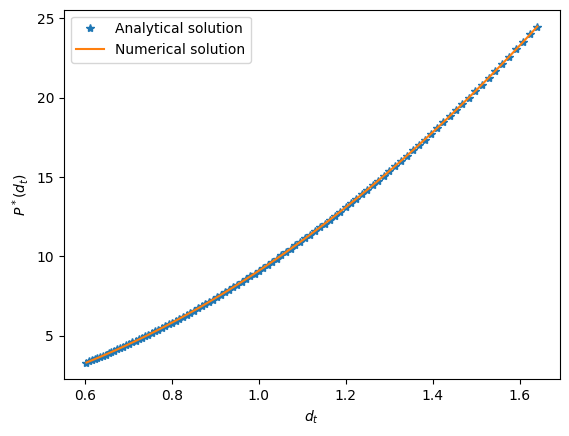
Case 3: Dividends that are a geometric random walk with drift
The notes also show that if the dividend process is
so that , then we have
which, when , reduces (as it should) to
CRRA = 2
Disc = 0.9
σ = 0.1
γ = 0.3

# Create a random walk dividend process
# (it turns out that the whole model can be normalized by d_t, and
# in normalized, terms the dividend proces becomes iid again)
rw_divs = DivProcess(γ=γ, α=0, σ=σ)

# And an economy that embeds it
rw_econ = LucasEconomy(CRRA=CRRA, DiscFac=Disc, DivProcess=rw_divs)
rw_econ.solve()

# Generate a function with our analytical solution
a_sol_factor = np.exp((CRRA - 1) * (CRRA * σ**2 / 2 - γ))


def a_sol_rw(d):
    return d**CRRA * a_sol_factor * Disc / (1 - Disc)


# Get a grid for d over which to compare them
dGrid = np.exp(rw_divs.getLogdGrid())

# Plot both
plt.figure()
plt.plot(dGrid, a_sol_rw(dGrid), "*", label="Analytical solution")
plt.plot(dGrid, rw_econ.EqPfun(dGrid), label="Numerical solution")
plt.legend()
plt.xlabel("$d_t$")
plt.ylabel("$P^*(d_t)$")
plt.show()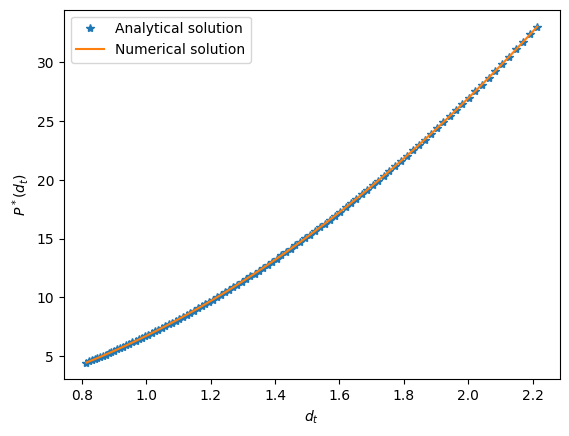
Testing our approximation of the dividend process
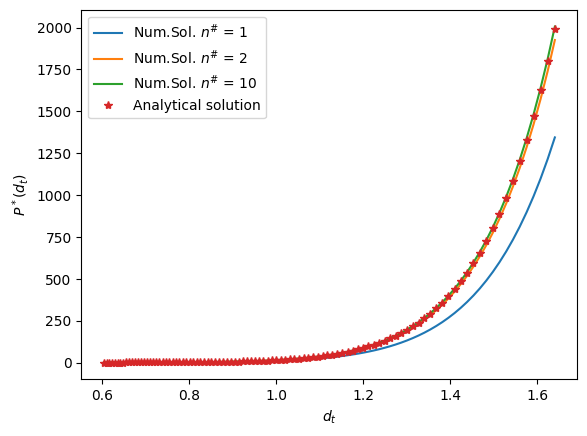
Hidden in the solution method implemented above is the fact that, in order to make expectations easy to compute, we discretize the random shock , which is to say, we create a discrete variable that approximates the behavior of . This is done using a Gauss-Hermite quadrature.
A parameter for the numerical solution is the number of different values that we allow our discrete approximation to take, . We would expect a higher to improve our solution, as the discrete approximation of improves. We test this below.
# Increase CRRA to make the effect of uncertainty more evident.
CRRA = 10
Disc = 0.9
σ = 0.1
ns = [1, 2, 10]

dTil = np.exp((σ**2) / 2 * CRRA * (CRRA - 1.0))


def aSolIID(d):
    return d**CRRA * dTil * Disc / (1 - Disc)


dGrid = np.exp(iidDivs.getLogdGrid())

plt.figure()
for n in ns:
    iidDivs = DivProcess(α=0.0, σ=σ, nApprox=n)
    iidEcon = LucasEconomy(CRRA=CRRA, DiscFac=Disc, DivProcess=iidDivs)
    iidEcon.solve()
    plt.plot(dGrid, iidEcon.EqPfun(dGrid), label="Num.Sol. $n^\#$ = {}".format(n))

# Plot both
plt.plot(dGrid, aSolIID(dGrid), "*", label="Analytical solution")
plt.legend()
plt.xlabel("$d_t$")
plt.ylabel("$P^*(d_t)$")
plt.show()